
IN BRIEF
Structural variants are large DNA changes, such as deletions and inversions, that can be difficult to identify against one reference genome.
SVPG uses a pangenome graph and two complementary methods to detect both shared and sample-specific changes.
The authors report better rare and somatic variant detection and nearly tenfold faster graph augmentation in a twenty-sample comparison.
WHY IT MATTERS
A single reference genome makes comparisons convenient but fails to represent the full range of human structural differences. Important changes in complex DNA regions can therefore be difficult to classify.
A graph representing more individuals could help research teams distinguish common genomic configurations from rare or acquired mutations, including those studied in cancer.
WHAT IS NOW POSSIBLE
Before: incomplete representation and slower graph rebuilds constrained long-read variation studies. Now: genome graph-aware calling and nearly tenfold faster augmentation were measured on the studied data.
WHAT MADE IT POSSIBLE
Long-read sequencing spans larger segments of DNA. SVPG aligns these reads to pathways in a pangenome graph and examines changes in their structure.
One mode refines candidate calls using the graph, while a second mode searches the graph directly for changes absent from the existing reference.
THE STORY
For decades, finding a large structural change in DNA generally meant comparing an individual's genome with a single human reference sequence. Yet one reference does not represent every possible arrangement of complex regions. Researchers have developed SVPG to work against a pangenome, a graph containing many alternative genomic paths. Published in Nature Methods on 21 September 2026, the method improved structural variant identification in sequencing datasets and accelerated the addition of new samples to reference graphs.
Structural variants are DNA rearrangements longer than 50 base pairs, including insertions, deletions, duplications and inversions. Some are widespread, others are rare to one individual or acquired by tumor cells. Algorithms using a linear reference may mistake normal diversity for variation or miss changes in repetitive regions. SVPG instead interprets long-read signals in the context of known pangenome alternatives.
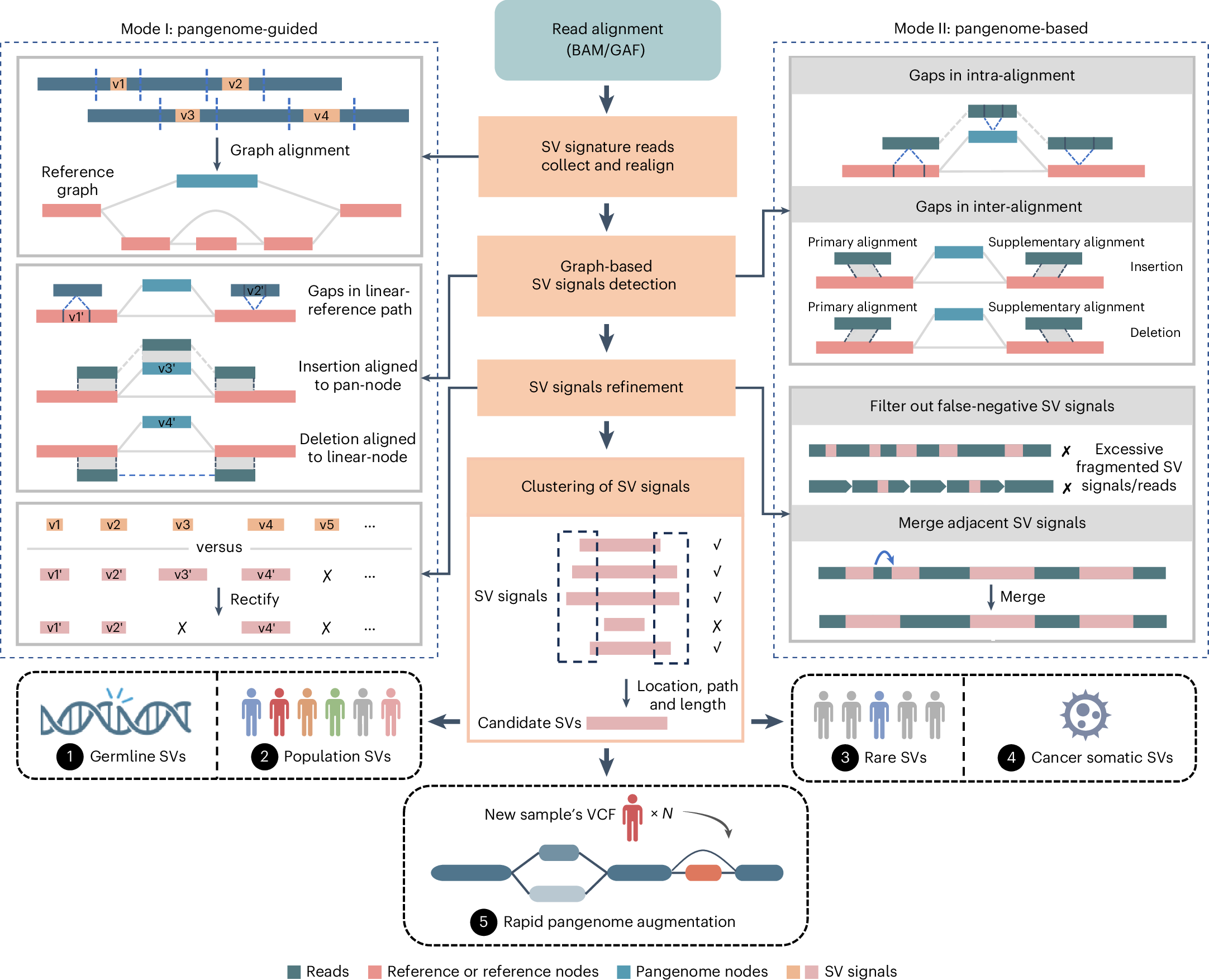
The tool has two modes. The pangenome-guided approach starts with potential structural changes and realigns their signals within the graph, improving breakpoint precision and filtering likely false positives. The pangenome-based approach analyzes read paths directly and detects changes that were not yet incorporated into the reference. According to the researchers, these methods improved rare and somatic structural variant calls in the tested datasets, including cancer-associated sequencing data.
The team compared SVPG with existing structural-variant callers on long-read data from Oxford Nanopore and PacBio platforms, using Genome in a Bottle reference sets as ground truth. Benchmarks spanned read coverage levels, complex genomic regions and different sample types. SVPG performed favorably under the tested conditions. That does not establish that every call is a newly discovered disease-causing mutation or independently verified clinical finding.
A second contribution is computational. Adding new genomes to a pangenome graph can require extensive assembly and realignment. SVPG integrates newly detected variants back into the graph and was nearly ten times faster in a twenty-sample augmentation benchmark than the traditional approach used as a comparator. This is a measured engineering improvement. Whether it leads to better rare-disease diagnoses or personalized cancer treatments remains a separate, unproven question.
WHAT WE KNOW
SVPG was compared with structural variant callers using long-read and Genome in a Bottle reference data. [1]
The authors report improvements for rare and somatic variation in the evaluated datasets.
Graph augmentation with twenty samples was nearly tenfold faster in a reported benchmark.
WHAT WE DON'T KNOW
The findings may not generalize equally to all ancestries, graphs or sequencing technologies.
Benchmarked calls are not by themselves verified clinical disease mechanisms.
No improvement in patient diagnosis or treatment from use of SVPG was demonstrated.
WHAT HAPPENS NEXT
Benchmark the method independently with larger, more representative graph references.
Confirm clinically interesting variants using orthogonal methods.
Evaluate costs and accuracy in real genomic workflows.
SOURCE TRACE
SVPG updated a graph with twenty samples nearly ten times faster.
SVPG improved rare and somatic variant calls against selected comparators.
The work validates genomic calling, not patient-level clinical benefit.
SOURCES
- SVPG: a pangenome-based structural variant detection approach and rapid augmentation of pangenome graphs with new samplesOpen source
- SVPG: a pangenome-based structural variant detection approach and rapid augmentation of pangenome graphs with new samplesOpen source
CURRENT EVIDENCE
PEER-REVIEWED
REAL SEQUENCING DATA COMPUTATIONAL VALIDATION / NO CLINICAL DEPLOYMENT
WHAT WOULD CHANGE THIS?
- Independent benchmarks could narrow or confirm performance advantages.
- Laboratory confirmation of rare variants would strengthen biological interpretation.
- Clinical studies could test whether the software improves patient diagnosis.