
IN BRIEF
Mixed chloride and iodide complexes make tin redox transitions reversible, potentially involving four electrons.
A complete tin-bromine research battery reached 89% energy efficiency at 40 mA per square centimetre.
It delivered 227 Ah/litre anolyte capacity and 205 Wh/litre anolyte energy density, while a kilowatt-scale stack ran stably for over 1,000 hours.
WHY IT MATTERS
Flow batteries store electricity in liquids circulating through electrochemical cells. They can serve stationary storage, but tank volume and chemical costs affect viability.
Tin has promising redox capacity, yet some conversion steps were hard to reverse. The new chemistry addresses this problem and was tested beyond a single small laboratory cell.
WHAT IS NOW POSSIBLE
Before: irreversible tin conversion limited capacity. Now: mixed coordination reduced the peak-potential gap and enabled a working kilowatt-scale aqueous storage stack.
WHAT MADE IT POSSIBLE
Iodide stabilizes intermediate tin complexes that lower molecular reorganization barriers, while chloride maintains solubility at high concentration.
The measured peak-potential gap for Sn4+/Sn2+ redox decreased from 978 to 97 millivolts in the reported comparison.
THE STORY
Flow batteries store electrical energy in liquid electrolytes that circulate between tanks and electrochemical modules. Increasing the energy held in each litre requires concentrated reactions that can be reversed efficiently. Chinese researchers have now developed a tin-based solution that addresses a longstanding barrier and moved its demonstration from a small cell to a kilowatt-scale stack. The findings appeared in Nature Chemistry on 9 October 2026.
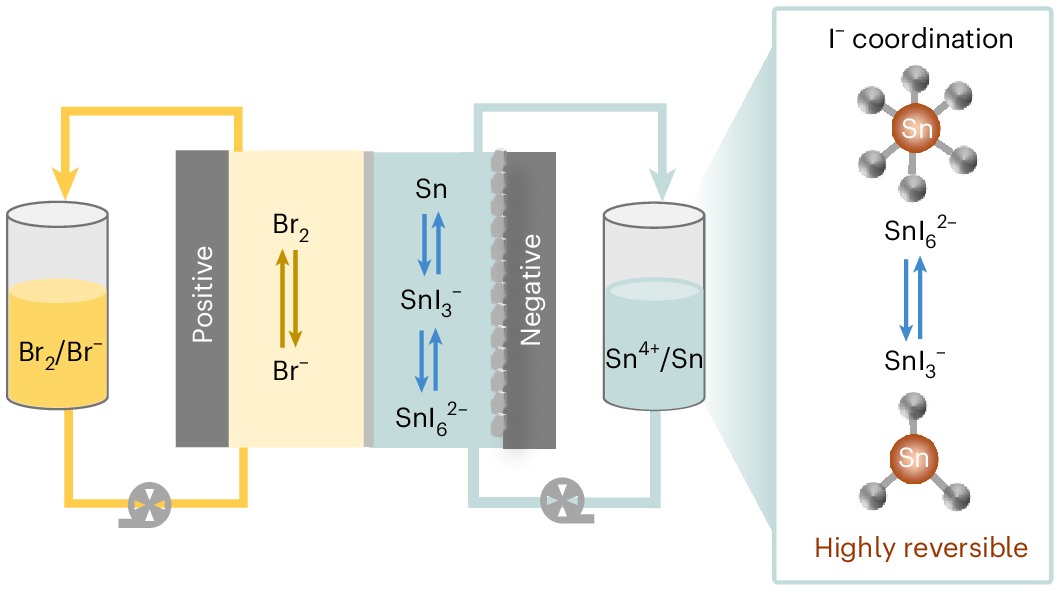
Tin can participate in four-electron chemistry, making it a candidate for high volumetric capacity. In aqueous solutions, however, the transformation between tin(IV) and tin(II) has been difficult to reverse efficiently. Part of the barrier comes from large rearrangements of chemical complexes as electrons move. The researchers added iodide to concentrated tin chloride, obtaining mixed iodine and chlorine coordination environments with more favorable electrochemical properties.
The iodine-containing complex lowers reorganization energy during electron transfer, while the chlorine-containing complex allows highly concentrated dissolved tin. In electrochemical tests, the separation between oxidation and reduction peaks for the Sn4+/Sn2+ transition fell from 978 to 97 millivolts. That is a direct measure of a more reversible redox step, not in itself the efficiency of a complete energy-storage plant.
The researchers combined the tin anolyte with a bromide-bromine counterpart to make a full aqueous flow battery. It reached 89% energy efficiency at 40 mA/cm², 227 ampere-hours per litre of anolyte and 205 watt-hours per litre of anolyte. The last number applies to the negative-side active liquid rather than the installed system including tanks, membrane, pumps and electronics. Conflating these quantities would overstate practical whole-system energy density.
A kilowatt-scale stack ran stably for more than 1,000 hours, a meaningful physical scale-up beyond a bench measurement. Yet it does not establish years of grid operation, economic competitiveness or maintenance demands. Larger integrated systems, life-cycle testing and safe bromine handling are necessary before this chemistry becomes a mature stationary storage option.
WHAT WE KNOW
The tin redox peak-potential separation fell from 978 to 97 millivolts with iodide. [1]
Tin-bromine energy efficiency reached 89% at 40 mA/cm².
A kilowatt-scale stack ran for over 1,000 hours and the anolyte reached 205 Wh/litre.
WHAT WE DON'T KNOW
Whole-system energy density is lower than the anolyte-only figure once tanks and equipment are included.
Years-long reliability under grid conditions is not established.
Costs, compatibility and safe bromine management need larger tests.
WHAT HAPPENS NEXT
Combine more stacks and tanks into complete storage systems.
Measure extended cycling, maintenance and system losses.
Compare delivered cost and safety against other grid battery options.
SOURCE TRACE
Redox peak-potential gap fell from 978 to 97 mV.
Tin-bromine cell reached 89% energy efficiency at 40 mA/cm².
205 Wh/l of anolyte and a kilowatt stack for over 1,000 hours.
SOURCES
- Reversible Sn4+/Sn0 anode for high-energy-density flow batteriesOpen source
CURRENT EVIDENCE
PEER-REVIEWED
WORKING KILOWATT RESEARCH STACK / NOT GRID PRODUCT
WHAT WOULD CHANGE THIS?
- Full-system tests could establish realistic energy density.
- Multiyear operation would reveal long-term durability.
- Safety and economic comparisons could determine competitiveness.