
IN BRIEF
A regenerable redox mediator extracts residual lithium from simulated spent lithium iron phosphate battery material.
The process recovered 98% of the available lithium and formed thin lithium-metal foils directly.
In distinct tests, symmetric cells operated beyond 1,200 hours and full cells with NCM811 cathodes retained 91.4% of capacity after 400 cycles.
WHY IT MATTERS
Battery recycling could become more valuable if recovered elements emerge as usable electrodes rather than only separated raw chemicals.
High recovery in a controlled laboratory material does not establish industrial operating costs, emissions or performance with mixed commercial waste.
WHAT IS NOW POSSIBLE
Before: recovering lithium from spent LFP and making metal electrodes were separate steps. Now: a tested laboratory route directly links these operations.
WHAT MADE IT POSSIBLE
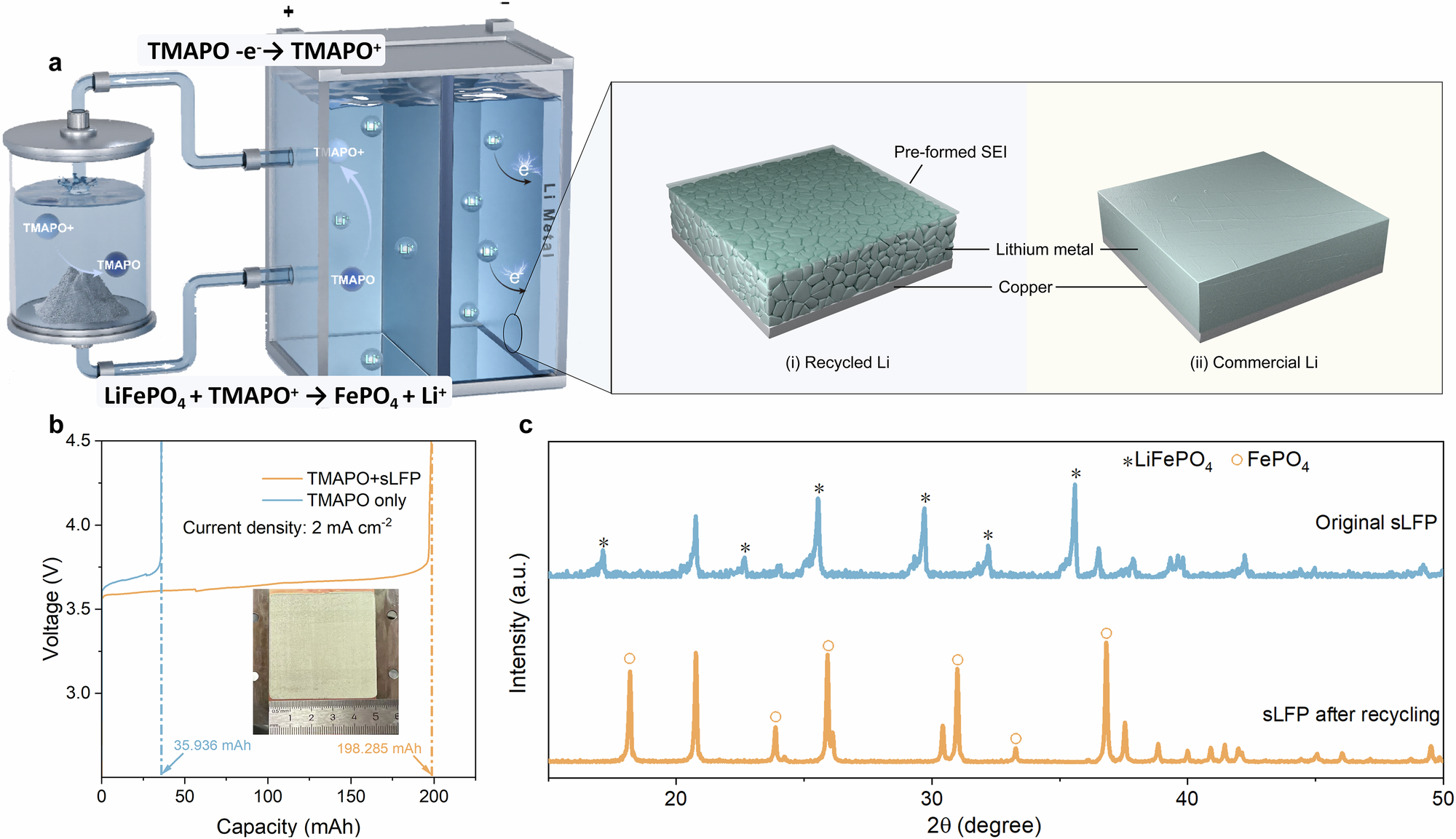
An electrochemical redox mediator facilitates electron transfer and lithium extraction from LFP powder and can be regenerated in the proposed cycle.
Recovered lithium is deposited as a tunable thin metallic film with a preformed interphase intended to stabilize subsequent operation.
THE STORY
An aging lithium battery still contains material that could become useful again. Extracting that material is only one step; turning it into a working electrode is another. Researchers have combined both in a laboratory process that converts powder simulating spent lithium iron phosphate batteries directly into thin lithium-metal foils. Their Nature Communications study, published on 15 October 2026, reports extracting 98% of the lithium available in the tested material.
Lithium iron phosphate, usually called LFP, is widely used partly because its cathodes do not rely on nickel or cobalt. But used LFP material still contains recoverable lithium. Many recycling routes first separate elements into intermediates before manufacturing battery-grade products. In the new method, a redox mediator helps release lithium from the simulated spent powder, while the process is designed to regenerate the mediator and recover the active metal in a more direct route.
The recovered product is not merely a powder: it is a thin metallic foil intended for the negative electrode of another battery. Researchers could vary its thickness, and the material formed a pre-existing surface layer that showed improved resistance to air corrosion and volume changes in their tests. The reported lithium loading corresponded to 4.14 milliamp-hours per square centimetre. That is an electrode-level areal-capacity measure, not the range of an electric car.
The team then checked whether the recovered lithium could actually operate in cells. Symmetric lithium-lithium test cells ran for more than 1,200 hours at a current density of 1 mA per square centimetre and 1 mAh per square centimetre per cycle. In separate cells paired with NCM811 cathodes, capacity retention was 91.4% after 400 cycles under specified conditions. These are two different tests, not a consumer battery life guarantee.
The main boundary lies at the beginning of the process. The powder was designed to simulate spent LFP; it was not a commercial stream of collected cells with impurities, adhesives and varying chemistries. An industrial version must still demonstrate energy balance, safe lithium-metal handling, process throughput and manufacturing cost. The verified result is a way to join lithium recovery with new electrode fabrication in one research-scale process, with potential to remove some intermediate steps.
WHAT WE KNOW
The laboratory route recovered 98% of the available lithium from simulated end-of-life LFP powder. [1]
The resulting lithium foil supplied 4.14 mAh/cm² of areal capacity.
Separate tests showed more than 1,200 hours of symmetric-cell operation and 91.4% capacity after 400 cycles in NCM811-coupled cells.
WHAT WE DON'T KNOW
Efficiency with contaminated real-world waste streams has not been shown.
Complete industrial energy and lifecycle costs remain unproven.
Commercial-cell safety and lifetime require further validation.
WHAT HAPPENS NEXT
Use actual mixed spent-LFP materials under realistic process conditions.
Measure mediator regeneration and energy demand over repeated continuous cycles.
Evaluate larger lithium foils and batteries for safety, durability and cost.
SOURCE TRACE
Electrochemical recycling recovered 98% of residual lithium from simulated spent LFP powder.
Recovered lithium formed thin foils with 4.14 mAh/cm2 capacity.
Li|Li symmetric test cells operated over 1200 hours at 1mA/cm2 and 1mAh/cm2.
NCM811 paired cells retained 91.4 percent capacity after 400 cycles under study conditions.
SOURCES
- Closed-loop upcycling of residual lithium in LiFePO4 into tunable thin lithium metal electrodesOpen source
CURRENT EVIDENCE
PEER-REVIEWED
WORKING LABORATORY RECOVERY / NOT INDUSTRIAL RECYCLING
WHAT WOULD CHANGE THIS?
- Real waste trials would test process robustness.
- Independent energy analysis could establish environmental benefits.
- Pilot production could establish scalability and electrode quality.