
IN BRIEF
NanoTS analyzes nanopore long-read RNA data to call single-nucleotide variants despite sequencing errors.
For variants supported by at least five reads, reported F1 scores exceeded 0.980 in direct RNA and 0.966 in cDNA evaluations.
The method also identified pathogenic variants in patient-derived cell lines, but it has not become a validated hospital diagnostic test.
WHY IT MATTERS
RNA sequencing reveals which genes are expressed and how transcripts are assembled. Higher nanopore error rates and uneven gene expression complicate separating real variants from technical artifacts.
Identifying variants and their expression in one workflow could support rare-disease research, provided independent testing establishes accuracy in real clinical settings.
WHAT IS NOW POSSIBLE
Before: RNA read errors and allele imbalance often disrupted calling. Now: a new method improves benchmark F1 and demonstrates pathogenic variant recovery in cultured patient-derived cells.
WHAT MADE IT POSSIBLE
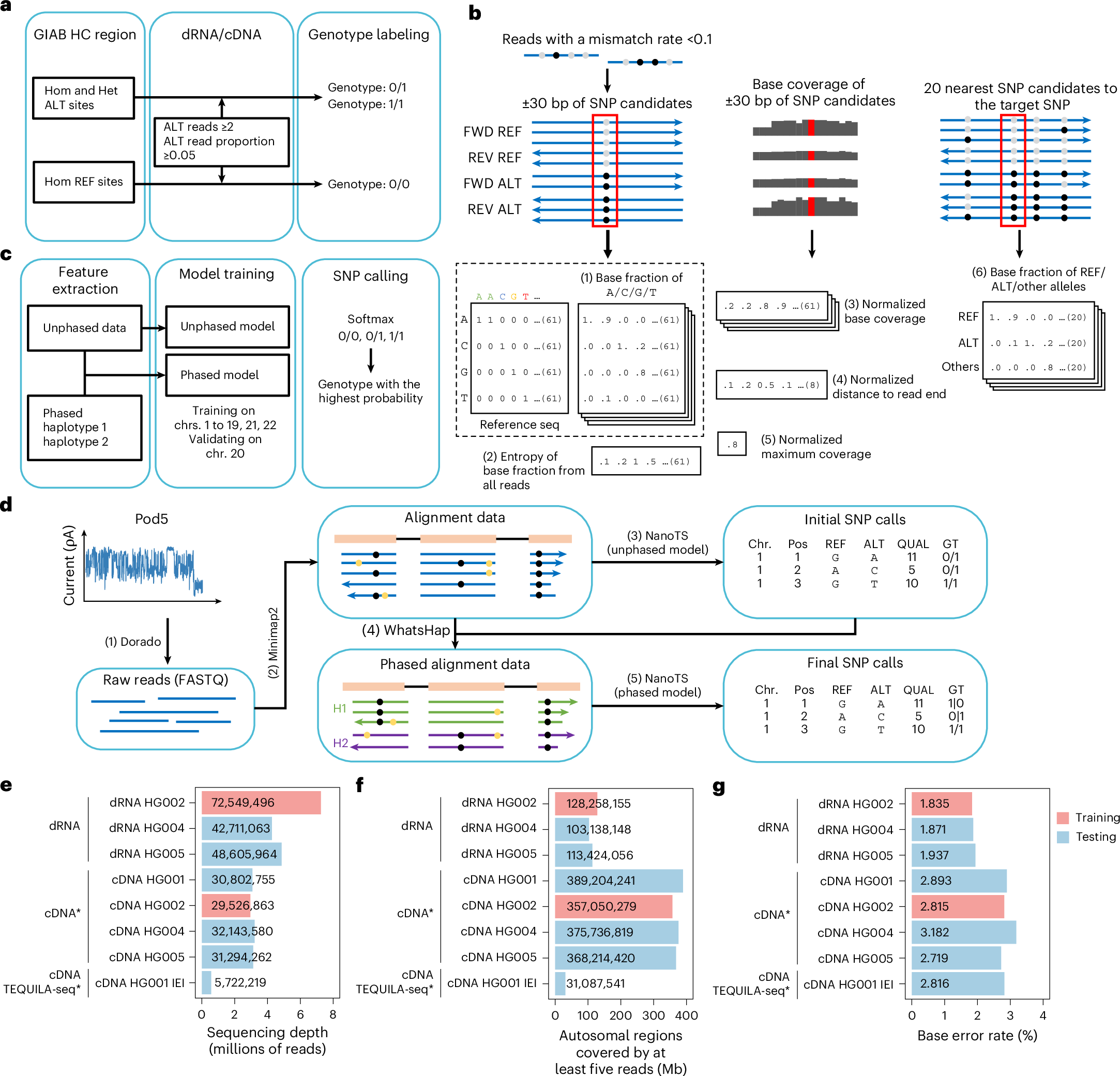
NanoTS combines local base composition, coverage, read position and quality features with allele phasing, grouping reads by their underlying haplotypes.
It was trained using high-confidence Genome in a Bottle references and compared with other long-read RNA variant callers.
THE STORY
Nanopore instruments can read long RNA molecules and reveal alternative transcripts, but sequencing errors and sharply different expression levels complicate reliable identification of single-base genetic changes. A research team at the Children's Hospital of Philadelphia developed NanoTS to address that problem. Published in Nature Methods on 22 September 2026, the method was tested against genetic reference data and explored using patient-derived cell lines associated with inherited disorders.
Instead of considering only which base appears at a genomic position, NanoTS evaluates local nucleotide proportions, read orientation, coverage, distance to read ends and other quality signals. A further pass adds haplotype information, identifying variants inherited together on the same chromosome copy. This is particularly useful when one allele is expressed much less strongly than the other and conventional callers can miss it.
The researchers trained their model with HG002 reference samples and high-confidence variants from Genome in a Bottle. For variants backed by at least five sequencing reads, NanoTS achieved F1 scores above 0.980 on nanopore direct RNA data and above 0.966 on cDNA data in the reported evaluations. F1 combines precision and recall against known reference calls. These scores do not mean 98 percent diagnostic accuracy for every patient sample or for poorly covered regions.
The study also moved beyond reference-only benchmarking. Fibroblast cell lines from people with Mendelian conditions were analyzed to assess recognition of pathogenic variants and their relationship with transcript processing. That shows the method can recover disease-relevant genetic information in material derived from patients. It does not show that using NanoTS in an actual clinical diagnostic pathway changes decisions or outcomes.
The tool and some evaluation datasets are publicly available; patient-derived data have access restrictions to protect privacy. Performance remains tied to particular sequencing platforms, read quality and expression coverage. NanoTS is a validated computational approach with initial biological sample testing, not an approved substitute for established diagnostic genetics workflows.
WHAT WE KNOW
Reported F1 scores exceeded 0.980 for direct RNA and 0.966 for cDNA at a minimum five-read support threshold. [1]
Haplotype integration improved variant identification where allele expression was imbalanced.
Pathogenic variants were examined in patient-derived cell lines for Mendelian disorders.
WHAT WE DON'T KNOW
Performance on weakly expressed genes or every tissue and sequencing platform is not established.
Prospective clinical accuracy in unselected patients remains unknown.
Benchmark scores and cell-line findings do not prove better treatment outcomes.
WHAT HAPPENS NEXT
Evaluate reproducibility across independent labs and platforms.
Compare variant calls with established clinical genetic tests.
Characterize limits from coverage, splicing and rare variant patterns.
SOURCE TRACE
With five supporting reads, F1 exceeded 0.980 in direct RNA and 0.966 in cDNA.
Haplotype phasing improves calls under allele expression imbalance.
Mendelian pathogenic variants were analyzed in patient-derived cell lines.
SOURCES
- NanoTS: a deep learning tool for accurate SNP calling in nanopore long-read transcriptome dataOpen source
- NanoTS: a deep learning tool for accurate SNP calling in nanopore long-read transcriptome dataOpen source
CURRENT EVIDENCE
PEER-REVIEWED
VALIDATED RNA SEQUENCING ANALYSIS / PATIENT CELL LINES, NOT CLINICAL DEPLOYMENT
WHAT WOULD CHANGE THIS?
- Independent studies could establish real-world performance limits.
- Prospective diagnostics trials could test clinical added value.
- Sequencing-platform changes may require revised training and calibration.