
IN BRIEF
MspA-FPBA combines a bacterial membrane pore with a chemical adapter that transiently interacts with different molecules.
It distinguished 21 proteinogenic amino acids, selected modified compounds, nucleotides, monosaccharides and short peptides.
With machine learning the platform reached overall classification accuracy of 98.7% in reported tests and analyzed yeast extracts and glycopeptides.
WHY IT MATTERS
Many single-molecule detectors are optimized for one chemical family. A sensor capable of reading sugars, protein building blocks and RNA-related molecules within one architecture could open broader analytical applications.
The 98.7% result is not diagnostic sensitivity for patients. It is a laboratory classification figure derived from specified analytes and test conditions.
WHAT IS NOW POSSIBLE
Before: narrow analyte scope in a single pore. Now: amino acids, sugars, nucleotides and peptides have been physically characterized and classified in one engineered sensor.
WHAT MADE IT POSSIBLE
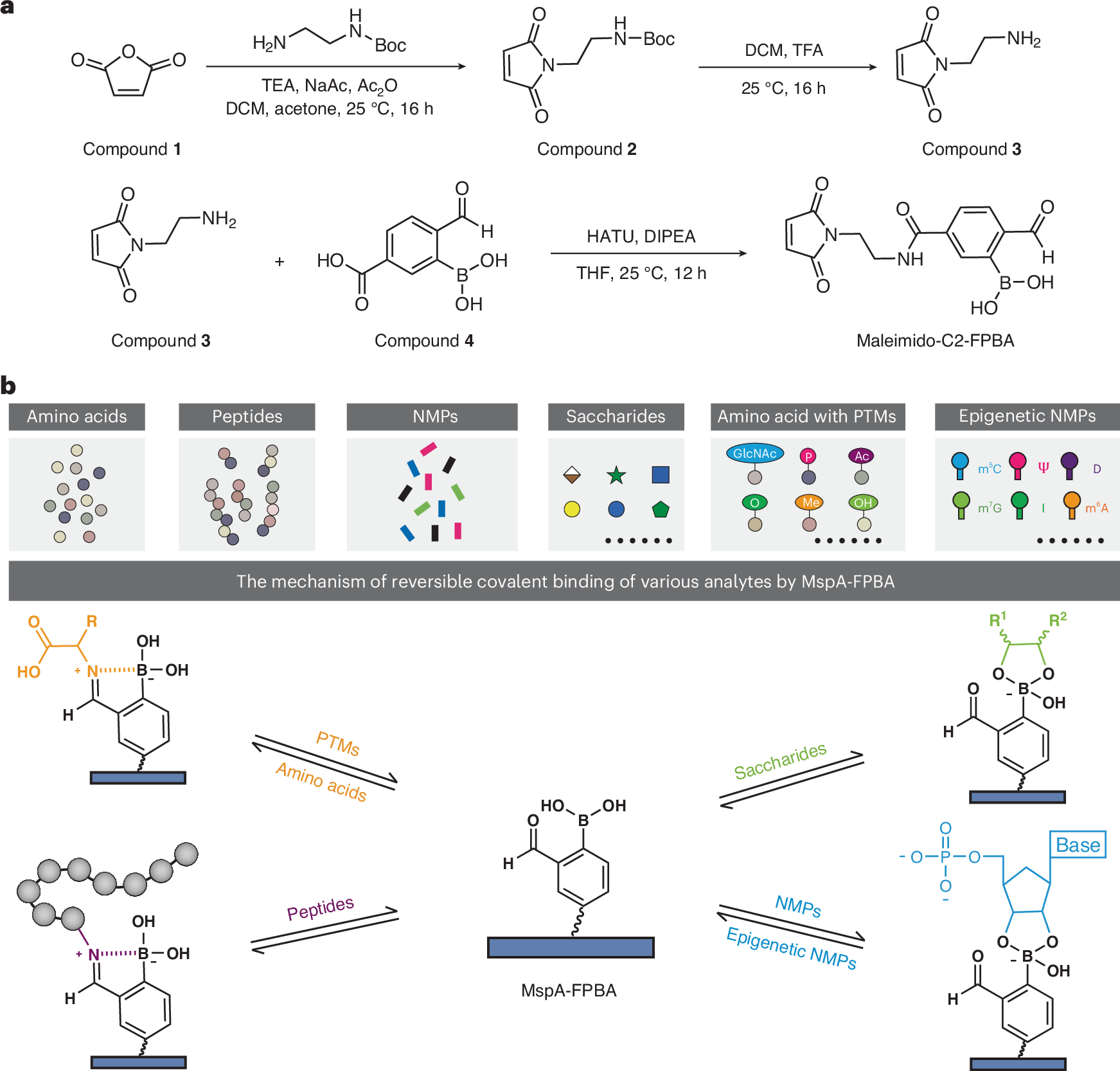
Researchers modified the constriction of the membrane pore MspA with a maleimido-C2-FPBA adapter capable of reversible interaction with diverse molecular groups.
Each interaction creates a distinct ionic-current fluctuation, which a machine-learning system recognizes from its characteristics.
THE STORY
A microscopic channel in a membrane can function as a chemical reader: when a molecule enters its pore, the ionic current changes briefly. Nanopore sensors have learned to distinguish certain compounds, but measuring many unrelated molecular families in one setup remains difficult. Researchers have now engineered MspA-FPBA, a pore that identifies sugars, amino acids, nucleotides and peptides with the same sensor architecture. The original experimental study appeared in Nature Biotechnology on 14 September 2026.
The starting point is MspA, a membrane protein from Mycobacterium smegmatis. A chemical adapter, maleimido-C2-formylphenylboronic acid, was attached near its narrow opening. This allows reversible interactions with different molecular structures. The interaction is long enough to generate a characteristic electrical signature, but does not permanently trap the sample.
The sensor discriminated 21 proteinogenic amino acids, three modified amino acids, four canonical nucleoside monophosphates, three modified nucleotides, four monosaccharides and five peptides. Together with machine learning, it reached 98.7% overall accuracy in controlled classification tests. That is notable because the measured compounds differ in size and chemistry. It does not imply 98.7% accuracy for every possible analyte or an unselected clinical sample.
The team also investigated classification of compounds absent from its archived signal database, using a few examples to learn their family characteristics. To test beyond purified standards, researchers recorded signals from yeast cell extracts and examined the constituents of a G2 glycopeptide, a compound containing sugar components linked to a peptide.
Those real molecule measurements distinguish the work from a software-only benchmark. Still, the system is not a universal sequencer that reads any biological molecule without preparation, and it has not been validated as a clinical diagnostic test. Further work must establish reproducibility across laboratories, quantitative performance, reliable mixture handling and integration into robust automated devices.
WHAT WE KNOW
A chemically adapted MspA nanopore experimentally read multiple molecular families. [1][2]
The authors report 98.7% overall classification accuracy under their tested conditions.
The platform was evaluated with yeast extract and glycopeptide constituents, in addition to purified standards.
WHAT WE DON'T KNOW
Recognition of arbitrary analytes in complex unprepared samples has not been shown.
The reported accuracy does not translate into patient diagnostic accuracy.
Independent-laboratory reproducibility and commercial operating reliability are not established.
WHAT HAPPENS NEXT
Expand testing to more complex mixtures and concentration ranges.
Evaluate quantitative accuracy and pore stability across repeated measurements.
Explore sample processing and automation for practical devices.
SOURCE TRACE
The nanopore recognized four chemical families in experimental sensing.
Machine learning achieved 98.7% classification accuracy in the study tests.
The sensor analyzed yeast extracts and glycopeptide composition.
SOURCES
- An engineered nanopore identifies saccharides, amino acids, peptides and ribonucleotidesOpen source
- A versatile nanopore identifies four classes of analytes simultaneouslyOpen source
CURRENT EVIDENCE
PEER-REVIEWED
WORKING LABORATORY NANOSENSOR / NO CLINICAL DEPLOYMENT
WHAT WOULD CHANGE THIS?
- Independent testing could confirm performance in complex samples.
- Repeatable concentration measurements could add analytical value.
- A robust automated platform would move the concept closer to a usable instrument.