
IN BRIEF
uRARE-seq sequences fragmented cell-free RNA in urine to identify molecular signals from urological cancers.
The reported sensitivity for localized bladder cancer was 95% at 90% specificity.
A 114-patient pretreatment analysis yielded a model with AUC 0.93 for distinguishing likely BCG versus chemotherapy response, not yet a proven treatment-selection tool.
WHY IT MATTERS
Bladder cancer often requires repeated surveillance, including invasive examinations. If validated independently, urine molecular measurements might inform monitoring while limiting unnecessary procedures.
Research sensitivity depends on study populations and selected thresholds. At 90% specificity, some cancer-free individuals could test positive; the result is not proof of performance in general-population screening.
WHAT IS NOW POSSIBLE
Before: urine cfRNA work mainly examined limited genes. Now: a broad sequencing approach demonstrates localized bladder cancer detection and treatment-response associations in clinical specimens.
WHAT MADE IT POSSIBLE
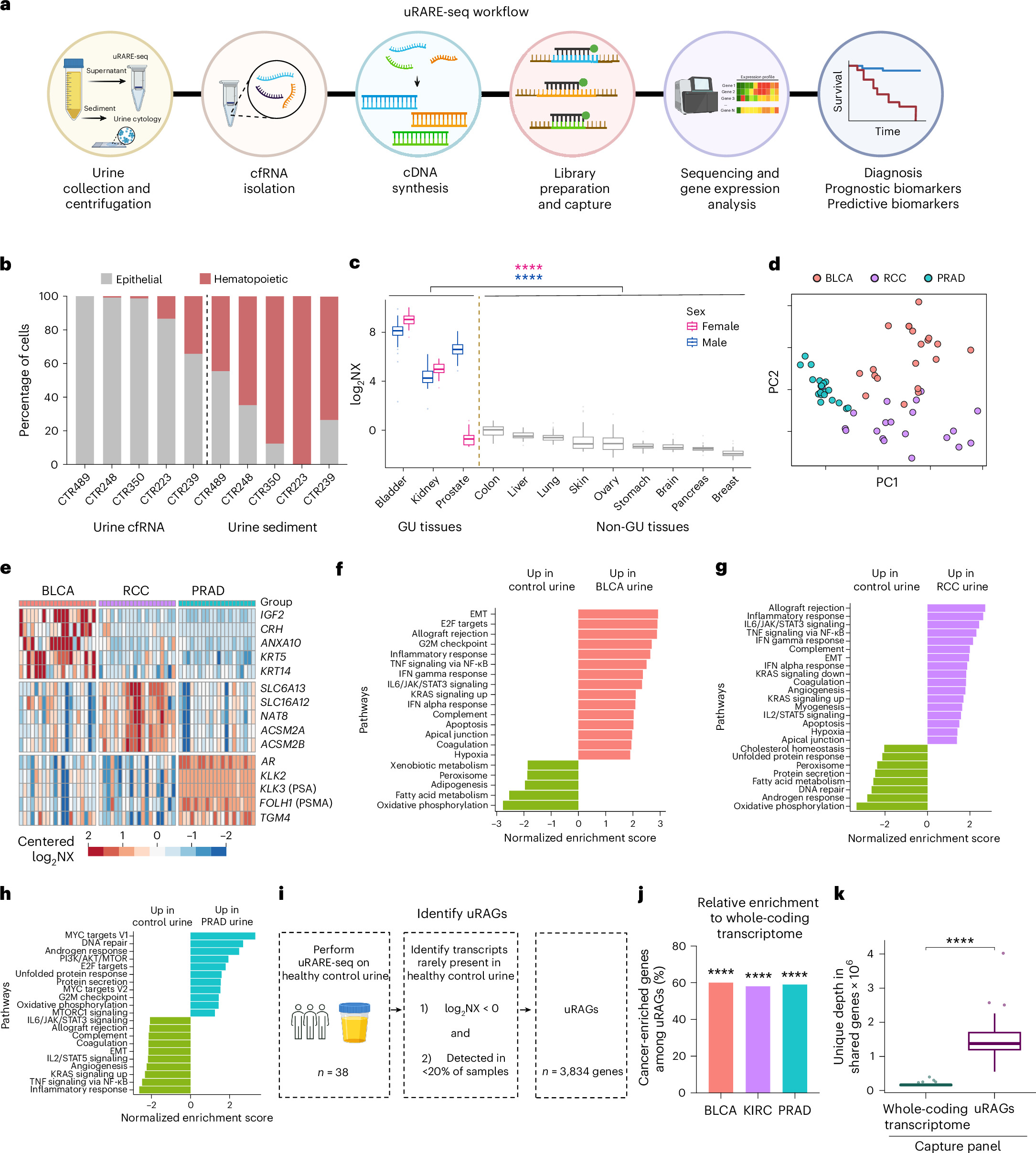
The researchers adapted an enrichment and sequencing method for short RNA fragments circulating freely in the liquid portion of urine.
These fragments can originate in bladder, kidney and prostate tissues and can include gene-expression signals from tumors and surrounding immune cells.
THE STORY
Urine contains molecular information beyond the cells or tumor DNA usually studied in liquid-biopsy tests. Stanford researchers have developed uRARE-seq, a technique to sequence cell-free RNA fragments in the liquid fraction of urine. A Nature Medicine paper published on 2 October 2026 applied it to 683 samples from patients with urological cancers and controls, reporting promising signals for detecting and monitoring bladder cancer.
Cell-free RNA is fragile and extensively fragmented. To recover it, the researchers adapted a molecular capture and sequencing method optimized for short pieces. The resulting profiles revealed expression patterns from bladder, kidney and prostate, including tumor-associated transcripts in patients with malignancies. Unlike a test that searches only for DNA mutations, RNA also provides clues about which genes are active in tissues and immune cells.
For localized bladder cancer, the paper reports 95% sensitivity at a threshold set for 90% specificity. Within this evaluation, the method identified most tumor-positive samples while accepting some false positives. Its reported performance exceeded the urine tumor-DNA comparator. However, these findings do not demonstrate that uRARE-seq could replace cystoscopy or function as a reliable screening tool for people without symptoms.
The team also explored minimal residual disease and molecular response after treatment. Before intravesical Bacillus Calmette-Guérin, or BCG, complete responders showed stronger T-cell and other immune signatures; nonresponders showed more proliferation-related gene expression. In urine collected before treatment from 114 patients, the investigators developed a model distinguishing relative likelihood of BCG versus chemotherapy response, reporting AUC 0.93. That is a discrimination metric within the study, not a demonstrated improvement in treatment outcomes.
An accurate-looking marker does not by itself establish that choosing care based on it improves survival or reduces recurrences. The work is a substantial biomarker research result, but not a randomized trial of test-guided treatment. The authors call for prospective studies and disclose ownership interests or stock options in Resero Bio for several contributors. Independent multicenter testing and clinical decision studies are necessary before the assay can become an established care option.
WHAT WE KNOW
uRARE-seq was studied in 683 urine samples from patients with cancers and controls. [1]
Localized bladder cancer detection had reported sensitivity of 95% at 90% specificity.
A 114-patient pretreatment response model reported AUC 0.93 for distinguishing treatment outcomes.
WHAT WE DON'T KNOW
Clinical performance in population screening or as a replacement for cystoscopy is not established.
Treatment-response AUC does not prove that model-guided therapy improves patient outcomes.
Independent prospective multicenter performance remains to be demonstrated.
WHAT HAPPENS NEXT
Validate detection and false-positive rates in prospective external cohorts.
Follow molecular signals longitudinally after treatment and during surveillance.
Test whether uRARE-seq-guided decisions improve outcomes compared with standard care.
SOURCE TRACE
The study included 683 urine samples from patients and controls.
Localized cancer detection reached 95% sensitivity at 90% specificity.
In 114 patients, model AUC was 0.93 without proof of benefit from test-guided therapy.
SOURCES
- Urine cell-free RNA for bladder cancer detection and treatment response predictionOpen source
- New urine test could improve bladder cancer diagnosisOpen source
- Urine cell-free RNA analysis for bladder cancer detection and monitoringOpen source
CURRENT EVIDENCE
PEER-REVIEWED
LABORATORY ASSAY ON CLINICAL URINE SAMPLES / NOT PROSPECTIVE CLINICAL UTILITY
WHAT WOULD CHANGE THIS?
- Prospective cohorts could confirm or revise sensitivity and specificity.
- Trials of test-guided care could establish clinical benefit.
- Standardized comparisons with cystoscopy could define an appropriate role.