
IN BRIEF
The analysis included 1,038 people with resectable advanced melanoma from 26 international centers.
Among those who received checkpoint immunotherapy and achieved major pathological response, estimated overall survival at five years was 98%.
Different trial and routine-care cohorts were pooled; the association does not establish that surgery or additional treatment can be safely skipped.
WHY IT MATTERS
When someone faces melanoma surgery, the tissue removed at the operation can show how strongly the tumor responded to treatment given beforehand.
An encouraging survival figure is useful only with its boundaries: the 98% applies to major responders and is neither an individual guarantee nor a reason to stop prescribed treatment.
WHAT IS NOW POSSIBLE
Before: 192 patients and shorter outcomes dominated INMC pooled reports. Now: 1,038 patients with five-year analysis provides more mature evidence of prognostic pathological response.
WHAT MADE IT POSSIBLE
An international consortium combined patient-level information from clinical trials and routine-care cohorts, using pathological response and survival analyses.
The five-year follow-up expands a 2021 consortium analysis of just 192 patients with shorter follow-up.
THE STORY
A patient with resectable advanced melanoma may receive immunotherapy while the tumor is still present, before surgery. What can doctors learn from the treated tissue that is subsequently removed? In an international pooled analysis of 1,038 patients, estimated five-year overall survival was 98% among those who achieved major pathological response to checkpoint immunotherapy. It is an encouraging result, but applies to a defined subgroup and is not a personal guarantee for everyone treated.
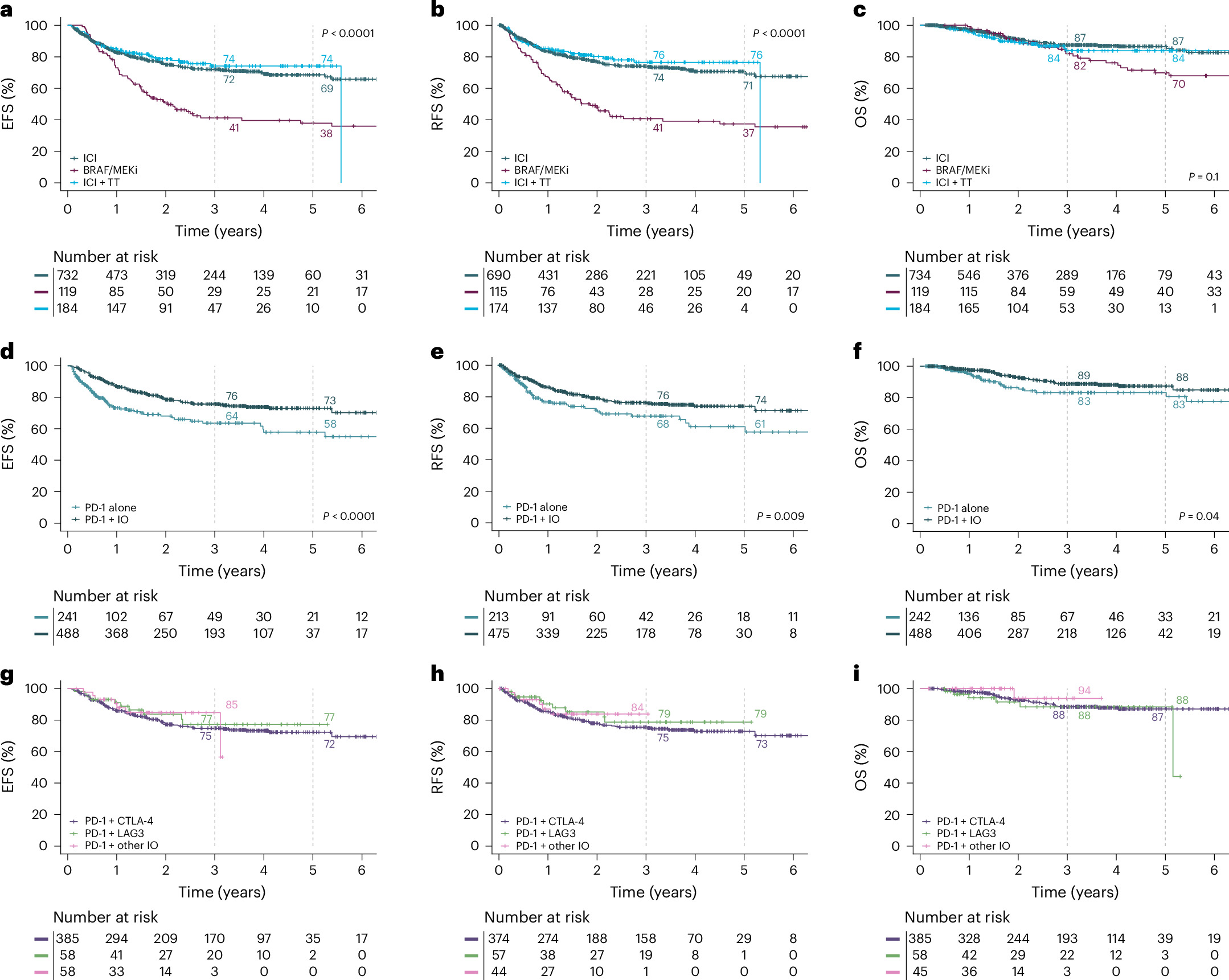
The International Neoadjuvant Melanoma Consortium study, published in Nature Medicine on 1 October 2026, combined patients from 26 centers. Of 1,038 people, 735 received immune checkpoint inhibitors, 119 BRAF/MEK targeted drugs, and 184 combinations of immunotherapy and targeted therapy. Some participated in trials, while others received treatment outside trials. The larger dataset is valuable, but these options were not all assigned randomly within one head-to-head experiment.
Major pathological response describes a surgical tissue sample with very few remaining viable tumor cells. It differs from simply observing a smaller mass on an imaging scan. This response occurred in 57.8% of checkpoint-treated patients. Rates varied between regimens, but direct numerical comparisons across pooled groups may reflect who entered each treatment cohort as well as the drugs themselves.
The five-year outcomes differed sharply by response. Estimated overall survival reached 98% among major immunotherapy responders. Five-year recurrence-free survival was 92.7% among patients with complete pathological response, compared with 35.2% among pathological nonresponders. These endpoints answer different questions: survival and remaining free of recurrence are not interchangeable. The findings support pathological response as a prognostic signal, but association alone does not prove that response itself causes the favorable outcome.
The practical question is what treatment should follow surgery. Among major responders, the pooled analysis did not identify a clear added advantage from adjuvant immunotherapy, but those comparisons were not uniformly randomized. This is not an instruction to stop medication or alter surgical care. Dedicated trials must test response-guided decisions while accounting for recurrence risk and treatment harms. The advance here is stronger five-year evidence to guide future research, not a settled answer for every treatment choice.
WHAT WE KNOW
The pooled analysis includes 1,038 patients across 26 centers and reports outcomes up to five years. [1]
Major pathological response after neoadjuvant immunotherapy was associated with estimated five-year overall survival near 98%.
Patients with complete pathological response had much higher recurrence-free survival than nonresponders.
WHAT WE DON'T KNOW
Pooled cohorts cannot prove that one immunotherapy combination is causally superior for every patient.
Pathological response alone does not justify omitting surgery or adjuvant treatment.
Small clinical subgroups may have imprecise survival estimates.
WHAT HAPPENS NEXT
Test response-guided surgery and adjuvant strategies in randomized studies.
Develop biomarkers identifying people unlikely to respond to the first regimen.
Extend survival and toxicity follow-up in smaller patient subgroups.
SOURCE TRACE
The study includes 1,038 patients at 26 sites, 735 given checkpoint immunotherapy.
Major pathological response occurred in 57.8% of checkpoint-treated patients.
Estimated five-year overall survival among major immunotherapy responders was 98%.
Five-year recurrence-free survival was 92.7% with complete response and 35.2% with no response.
SOURCES
- Five-year survival with neoadjuvant therapy in melanoma: updated pooled analysis from the International Neoadjuvant Melanoma Consortium (INMC)Open source
- Five-year survival with neoadjuvant therapy in melanoma: updated pooled analysisOpen source
EVIDENCE & UPDATE HISTORY
- Initial publication record
PEER-REVIEWED
- Story updated
PEER-REVIEWED
Updated: Deck, In Brief, Why It Matters, The Story, 10-Second Takeaway
CURRENT EVIDENCE
PEER-REVIEWED
REAL PATIENT LONG-TERM SURVIVAL / OBSERVATIONAL POOLED ANALYSIS
WHAT WOULD CHANGE THIS?
- Randomized response-guided trials could establish which postsurgical therapies are necessary.
- Better biomarkers could identify patients unlikely to respond.
- Longer subgroup follow-up could refine estimates.