
IN BRIEF
Visionary AI measures retinal vessel geometry to predict preeclampsia before clinical diagnosis.
Following development using 1,267 pregnancies, an external test evaluated 66 participants with 13 events, yielding AUC 0.81.
An earlier preprint described the project in 2025; the material 2026 milestone is transfer to another hospital's data.
WHY IT MATTERS
Preeclampsia threatens the health of pregnant patients and babies. A non-invasive early risk signal could improve assessment if it performs reliably in wider clinical settings.
Predictive performance in dozens of patients cannot demonstrate effective population screening or better pregnancy outcomes.
WHAT IS NOW POSSIBLE
Before: performance described in preprint with a single-site development cohort. Now: a limited independent-site external evaluation supports cross-site prediction, not routine clinical deployment.
WHAT MADE IT POSSIBLE
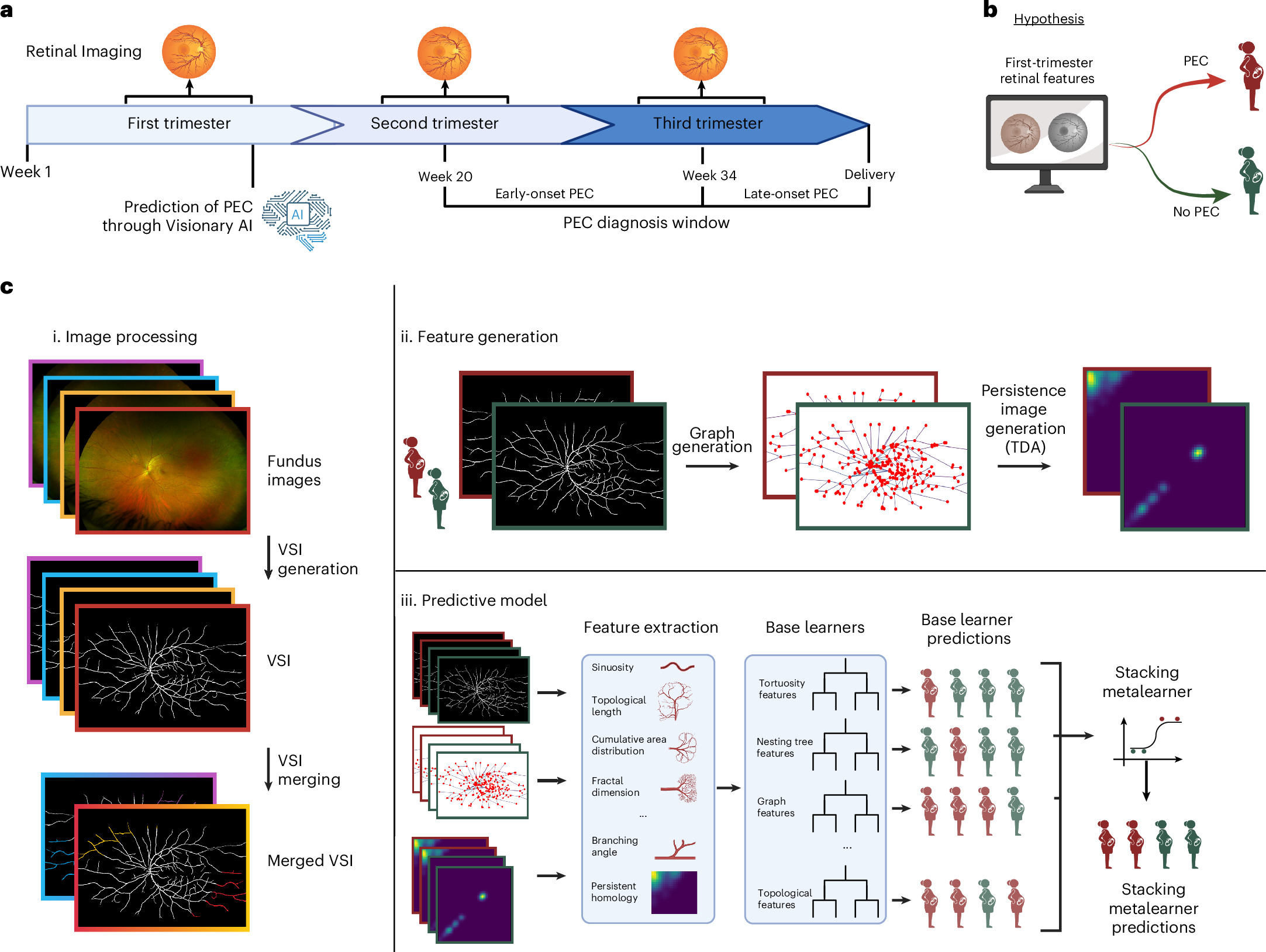
Widefield retinal photographs show small blood vessels. The model represents their branching, geometry and network complexity as interpretable features.
The researchers applied a stabilized model to an external hospital cohort without retraining it on the patients' outcomes.
THE STORY
Images of blood vessels at the back of the eye may carry early clues to preeclampsia risk. Visionary AI analyzes that vascular structure during pregnancy. A Nature Biotechnology paper published on 6 October 2026 represents an important next test, not the original invention of the model: the same research team released a preprint in November 2025. What changed is evidence from another hospital, with encouraging predictive performance but substantial uncertainty.
The model was developed using a prospective Columbia University cohort of 1,267 pregnancies. Retinal blood vessels are converted into interpretable measurements of branching, shape and network organization. Those features can reflect systemic vascular changes associated with later preeclampsia. An association does not imply that retinal abnormalities cause the disorder; the eye is being investigated as an accessible marker of wider circulation.
The more demanding evaluation took place at New York University. The external cohort enrolled 79 pregnancies, but 66 participants were evaluable in the first-trimester retinal analysis, including 13 who developed preeclampsia. Without training on those outcomes, Visionary AI achieved an area under the ROC curve, or AUC, of 0.81 and average precision of 0.68. In the same external comparison, the Fetal Medicine Foundation clinical risk calculator had AUC 0.73 and average precision 0.50.
An AUC of 0.81 measures how well the model ranks people who do and do not later develop the condition. It does not mean that 81 percent of pregnancies would receive the correct clinical diagnosis, nor does it establish a safe screening threshold. With only 13 cases, estimates of missed cases and false alarms remain imprecise. Disease prevalence in the validation sample also differed from the hospital's usual population, limiting direct translation to routine care.
The study shows that retinal vessel patterns preserved useful predictive information when tested at an independent hospital. It did not show that using Visionary AI changes treatment decisions safely or improves maternal and infant outcomes. Larger multicenter validation, calibration under routine prevalence and trials of clinical decisions are necessary. The demonstrated advance is an early external test, not a proven intervention.
WHAT WE KNOW
The 2026 peer-reviewed paper includes an external assessment without retraining in 66 evaluable pregnancies, including 13 cases. [1][2]
External AUC was 0.81 and average precision 0.68.
The method measures geometry and topology of retinal vascular networks.
WHAT WE DON'T KNOW
Performance in unselected population screening is not established.
No benefit to maternal or newborn health from using this risk score was demonstrated.
Different populations and imaging hardware could change performance.
WHAT HAPPENS NEXT
Repeat validation in larger multicenter pregnancy cohorts.
Determine calibration, false-positive rates and detection thresholds under routine prevalence.
Test whether decisions guided by the model improve care outcomes.
SOURCE TRACE
The external retinal evaluation included 66 participants and 13 preeclampsia cases.
The external test reached AUC 0.81 and average precision 0.68 without establishing clinical benefit.
The project was documented in a November 2025 preprint.
SOURCES
- Decoding systemic vascular health and hypertensive disorders in pregnancy through retinal imaging and Visionary AIOpen source
- Visionary AI: Decoding Systemic Vascular Health and Hypertensive Disorders in Pregnancy Through Retinal Imaging and Artificial IntelligenceOpen source
CURRENT EVIDENCE
PEER-REVIEWED
EXTERNAL RISK PREDICTION VALIDATION / NOT SCREENING DEPLOYMENT
WHAT WOULD CHANGE THIS?
- A large external cohort would narrow uncertainty in performance estimates.
- Real-world calibration would show how many false alarms to expect.
- A clinical trial could test whether model-guided care improves outcomes.