
IN BRIEF
Otter 24C launched from Vandenberg on 1 October 2026 aboard Transporter-18.
The SSPICY mission will test autonomous navigation, cameras and electric propulsion near as many as four inactive objects.
NASA expects inspections to begin in 2027; the demonstration will not capture or repair satellites.
WHY IT MATTERS
Before a failed satellite can be repaired or removed, operators need to understand its spin, orientation and physical condition. Distant observations cannot answer every safety-critical question.
SSPICY has placed a dedicated inspector in orbit. The demonstrated result is a launch, not a reduction in space debris.
WHAT IS NOW POSSIBLE
Before: inspection capability depended on a planned launch. Now: Otter 24C has launched, although its target-approach capability awaits demonstration.
WHAT MADE IT POSSIBLE
Starfish Space built Otter 24C with electric propulsion, camera-based relative navigation, automatic guidance and an articulated thruster-pointing boom.
NASA's Small Spacecraft and Distributed Systems programme funds and manages the demonstration; the Transporter-18 rideshare enabled the launch.
THE STORY
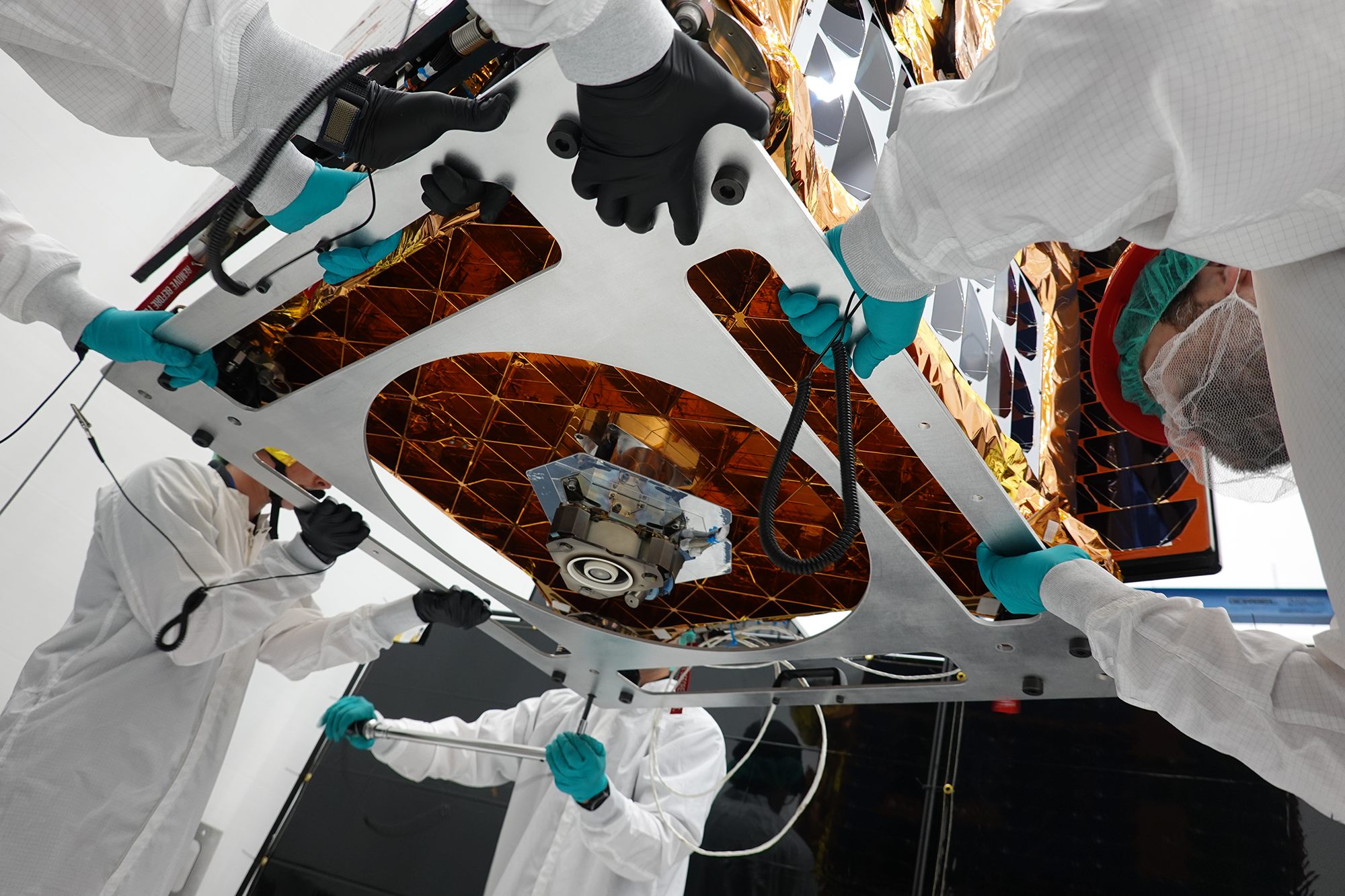
Before anyone can service a failed satellite, they need to approach it without creating another hazard. On 1 October 2026 a spacecraft designed for that task launched into space: Starfish Space's Otter 24C. It is carrying out SSPICY, a NASA-funded demonstration of orbital inspection technologies. The launch is confirmed. Close approaches to inactive objects have not yet begun.
Otter travelled aboard a Falcon 9 on the Transporter-18 mission from Vandenberg Space Force Base in California. NASA and independent launch reporting confirm the event. The spacecraft must now complete in-orbit commissioning. Public evidence does not yet establish that its integrated systems can safely manoeuvre near a tumbling, non-cooperative object.
The plan is to inspect as many as four inactive US-origin objects, including satellites and spent rocket stages. At distances of hundreds of metres, cameras and other sensors should estimate spin, orientation and surface condition. Guidance software will use those measurements to make approach decisions with limited control from the ground.
Electric propulsion is intended to move Otter between targets, while an articulated boom will redirect thrust during precise manoeuvres. NASA says these technologies will be tested together as one system near real orbital objects. Visits are expected to start in early 2027 and the mission is planned to operate for about two years. Those figures are mission targets, not completed inspections.
SSPICY will not dock with, repair or remove the objects it studies. If inspections succeed, they may provide data for later servicing and debris-removal missions. For now, the real change is an orbital platform built to collect information that engineers need before attempting those more demanding interventions.
WHAT WE KNOW
Otter 24C launched on 1 October 2026 aboard Transporter-18. [1][2][3]
NASA plans up to four inspections beginning in 2027.
SSPICY will not dock with, repair or remove the objects under inspection.
WHAT WE DON'T KNOW
No measured performance from actual close inspections has been published.
A successful launch is not proof of safe autonomous navigation around tumbling targets.
No reduction in orbital debris has yet been demonstrated by this mission.
WHAT HAPPENS NEXT
Complete in-orbit commissioning and subsystem checks.
Track the first approach attempts and release of navigation data in 2027.
Keep inspection results separate from claims about future capture or disposal missions.
SOURCE TRACE
Otter 24C launched on 1 October 2026 with Transporter-18.
SSPICY plans inspections of up to four inactive objects starting in 2027.
The mission will not touch or dock with the inspected objects.
SOURCES
- NASA's SSPICY Mission to Demonstrate In-Space Inspection TechnologiesOpen source
- NASA SmallSats Launch to Advance Science, Technology, Orbital OperationsOpen source
- SpaceX launches Google AI satellite, 129 other payloads on 2nd leg of spaceflight tripleheaderOpen source
CURRENT EVIDENCE
IN REAL USE
SPACECRAFT LAUNCHED / INSPECTION PENDING
WHAT WOULD CHANGE THIS?
- A documented first approach would demonstrate an operational capability beyond launch.
- Repeated safe inspections would validate the integrated guidance and propulsion system.
- A future capture or removal trial would test capabilities outside SSPICY's current mission.