
IN BRIEF
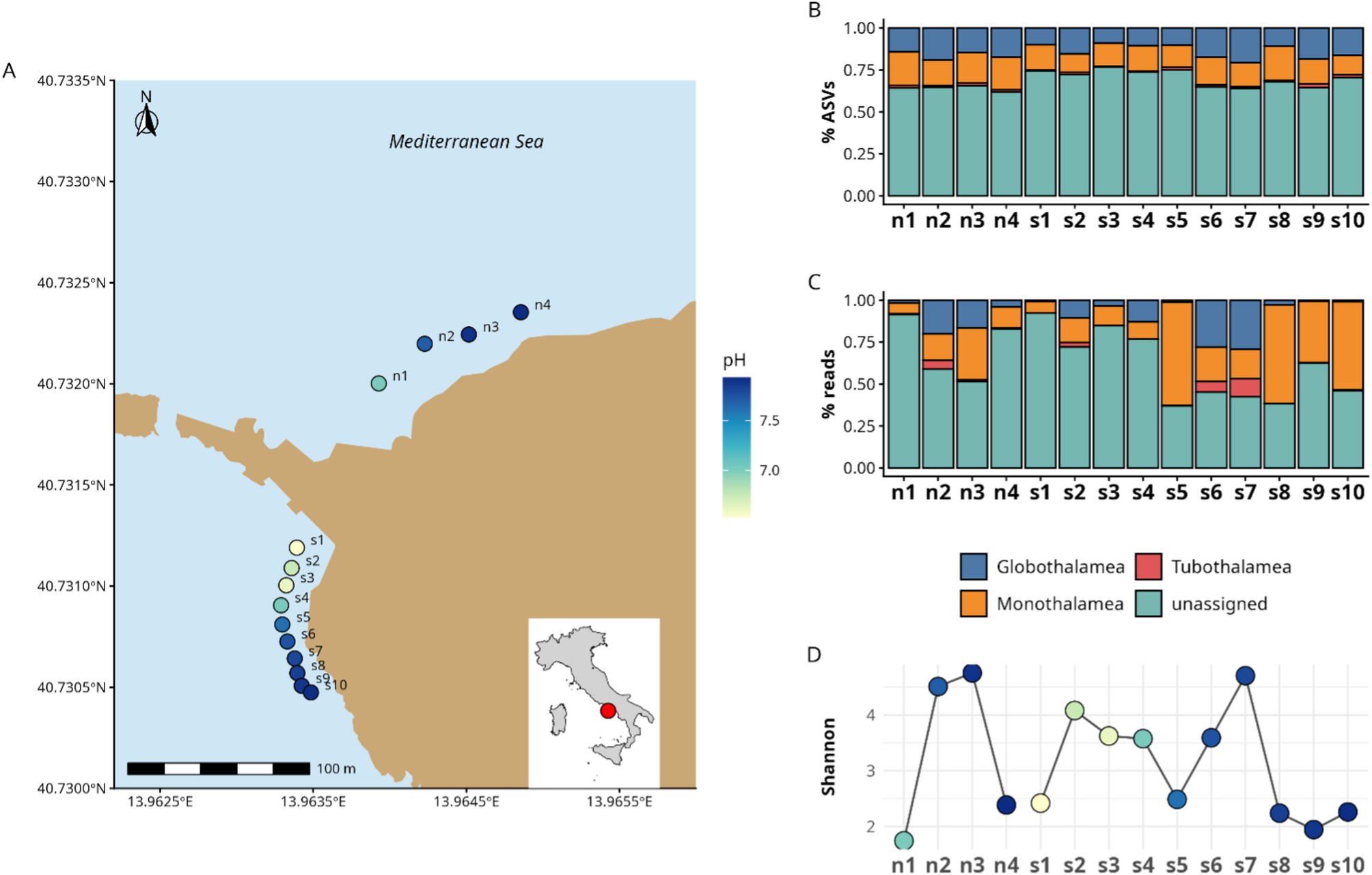
Seawater pH along two transects near natural CO₂ vents at Ischia ranged from 6.53 to 7.93.
DNA and shell-trait analyses indicated a shift in foraminiferal community composition around pH 7.7.
Under a very high-emissions scenario, many Mediterranean coasts are projected to cross that threshold by century's end; this is not a current measured condition throughout the basin.
WHY IT MATTERS
More acidic seawater changes carbonate availability for organisms building mineral shells.
A measurable biological transition helps interpret chemical change, but one numerical threshold cannot be assumed to apply to every marine ecosystem.
WHAT IS NOW POSSIBLE
Before: community reaction to pH was often described mainly by taxa counts. Now: in situ functional traits and genetic measurements identify a community transition near pH 7.7 at Ischia.
WHAT MADE IT POSSIBLE
Natural underwater carbon dioxide vents at Ischia create an unusually steep local acidity gradient.
The researchers combined molecular markers with shell morphology and then evaluated future scenarios spatially.
THE STORY
Near natural underwater CO₂ vents at Ischia, Italy, some seafloor communities encounter water far more acidic than surrounding marine habitats. This makes the area a natural laboratory for studying how changing chemistry could affect organisms. A Scientific Reports paper published on 8 October 2026 compared DNA and morphological traits of benthic foraminifera across two transects, finding a marked community shift around seawater pH 7.7.
Foraminifera are single-celled organisms. Some build calcium-carbonate shells, whereas others assemble protective structures from sediment particles. As acidity rises, calcification becomes more challenging and different forms may be favored. The measured samples ranged from pH 6.53 to 7.93. Along the gradient, the proportion of calcareous forms changed while functional traits captured the response more clearly than a simple count of species.
The study combined genetic marker sequencing with direct examination of shell morphology. Both approaches supported a transition near pH 7.7, with non-calcareous forms playing a greater role in more acidic sites. An important methodological limit is that many detected genetic sequences could not be assigned to named taxa. The result is therefore a community pattern in this particular natural environment, not a universal threshold for every marine species.
The scientists then applied the empirical pH reference to model projections for Mediterranean waters in 2090–2100. Under SSP5-8.5, a scenario with very high greenhouse gas emissions, substantial areas along western Mediterranean coasts and parts of the Adriatic could fall below the chosen level chronically or episodically. In one analysis, the exposed coastal seafloor region exceeds 400,000 square kilometres. Those figures are conditional climate projections, not a present-day observation that the communities across that area have already collapsed.
The contribution is a link between observed benthic biodiversity and a potentially meaningful biological threshold for future monitoring. Natural vents do not reproduce every aspect of climate change: temperature, oxygen, pollution and habitat interactions also shape marine life. The findings flag a plausible vulnerability rather than certain extinction, strengthening the case for emission reduction and local ecological surveillance.
WHAT WE KNOW
The observed Ischia gradient ranged from pH 6.53 to 7.93, with community composition changing along it. [1]
DNA and morphological traits suggested a transition around pH 7.7.
The estimated future geographical reach varies strongly by emissions scenario.
WHAT WE DON'T KNOW
A pH of 7.7 need not be a universal biological breakpoint.
Projected exposure is not current observed local species extinction.
Other stressors can change community responses.
WHAT HAPPENS NEXT
Test trait-based thresholds at other CO₂ gradient sites.
Monitor long-term benthic diversity and calcification.
Compare local measurements with projected chemistry and warming.
SOURCE TRACE
Two Ischia transects measured pH from 6.53 to 7.93.
Functional community composition shifted near pH 7.7.
Future Mediterranean threshold crossings are model projections, not present observations.
SOURCES
- Ocean acidification pushes Mediterranean marine calcifiers toward a tipping pointOpen source
CURRENT EVIDENCE
PEER-REVIEWED
OBSERVED BIOLOGICAL FIELD RESPONSE / FUTURE SCENARIO NOT REALIZED
WHAT WOULD CHANGE THIS?
- Other sites might produce different ecological thresholds.
- Long-term monitoring could test the predicted changes.
- Lower future emissions could substantially reduce exposed regions.