
IN BRIEF
Researchers subjected winter-state plants from three marsh species and mechanical mimics to significant waves up to two metres high.
Average biomass loss was about 30%, with stiff stems breaking more readily than flexible ones.
The results inform vegetation survival models but do not measure protection of a town during an actual storm.
WHY IT MATTERS
A marsh can reduce wave energy only while enough vegetation remains in place. Understanding survival matters to avoid overstating the safety offered to coastal communities.
The finding does not remove flood risk; it identifies a measurable plant trait that should inform protective design.
WHAT IS NOW POSSIBLE
Before: uncertain persistence of coastal vegetation under extreme wave loading. Now: measured average biomass survival and stem flexibility effects allow a more testable model.
WHAT MADE IT POSSIBLE
A large experimental facility generated controlled high-energy waves.
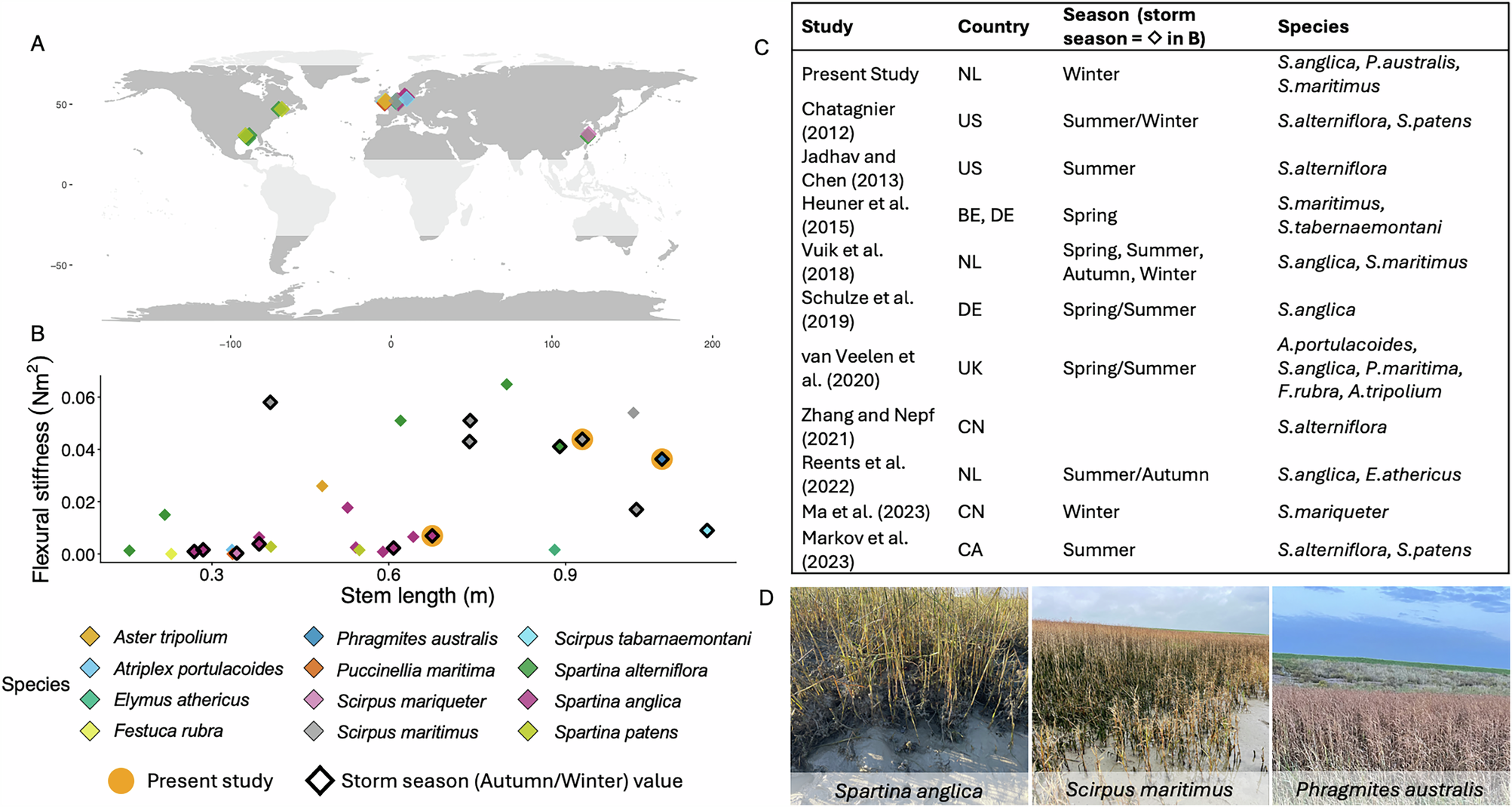
Researchers tested real winter-condition stems from three plant species alongside mechanical mimics, tracking breakage and biomass loss.
THE STORY
When a storm reaches a coastal marsh, the plants are more than a barrier that slows waves. Each stem can bend, snap or survive. Researchers recreated unusually intense waves in a large experimental facility and measured average biomass loss of about 30%. That is greater resilience than expected in the winter-state vegetation tested, but it does not prove that a marsh alone can protect every coastal community.
The study, published in Communications Sustainability on 8 October 2026, examined plants from three marsh species alongside mechanical mimics. Artificially generated significant waves reached two metres, with water levels up to four metres and peak periods up to eight seconds. Significant wave height describes a statistical feature of the wave field, not the height of each individual wave. Controlled tests made it possible to compare which stems stayed intact.
The key difference was how the plants responded to moving water. Stiff stems that could not bend readily were more likely to snap. Flexible stems moved with the waves and continued to occupy the water column. Across the experiments, mean measured biomass loss was 30%. What remained after severe loading tended to be a relatively more flexible canopy.
Using the breakage data, the scientists developed a way to relate stem traits and storm intensity to expected survival. That matters for coastal planning because a model treating all marsh vegetation as an unchanging obstacle may overestimate how much wave attenuation remains during a storm. The new measurements help estimate how much of the natural barrier could continue functioning as forcing increases.
A wave flume is not a real coastline. Root systems, moving sediment, salinity, currents, erosion and repeated storms interact in ways a controlled experiment cannot fully reproduce. The three tested species also represent only part of global marsh diversity. Real-world projects will need field observations and combinations of appropriate protective measures. What this research offers is a stronger measurement of vegetation resilience, not a promise that coastal risk disappears.
WHAT WE KNOW
The facility generated significant waves up to 2 metres with high water levels. [1]
Mean biomass loss was 30% in the experiments.
Flexible stems were less likely to break than rigid stems.
WHAT WE DON'T KNOW
The same loss rate may not apply to all real marshes and species.
Repeated or longer-term storms and sediment dynamics were not fully assessed.
Actual protection of particular communities was not evaluated in this trial.
WHAT HAPPENS NEXT
Validate estimates against post-storm observations in natural wetlands.
Extend testing across more species and seasonal conditions.
Incorporate vegetation damage into coastal flood-risk models.
SOURCE TRACE
Experimental significant waves reached 2m and water levels reached 4m.
Mean biomass loss of 30 percent.
Rigid stems broke more frequently than flexible ones.
SOURCES
- Enabling global prediction of marsh vegetation survival during extreme stormsOpen source
EVIDENCE & UPDATE HISTORY
- Initial publication record
PEER-REVIEWED
- Story updated
PEER-REVIEWED
Updated: Deck, In Brief, Why It Matters, The Story, 10-Second Takeaway
CURRENT EVIDENCE
PEER-REVIEWED
PHYSICAL LAB WAVE EXPERIMENT / NOT FIELD FLOOD DEPLOYMENT
WHAT WOULD CHANGE THIS?
- Observations after real storms could test transferability.
- Additional species tests could refine breakage thresholds.
- Coastal pilots could measure sustained protective performance.