
IN BRIEF
ESO-T01 generates BCMA CAR-T cells directly inside the body, without ex vivo cell manufacturing.
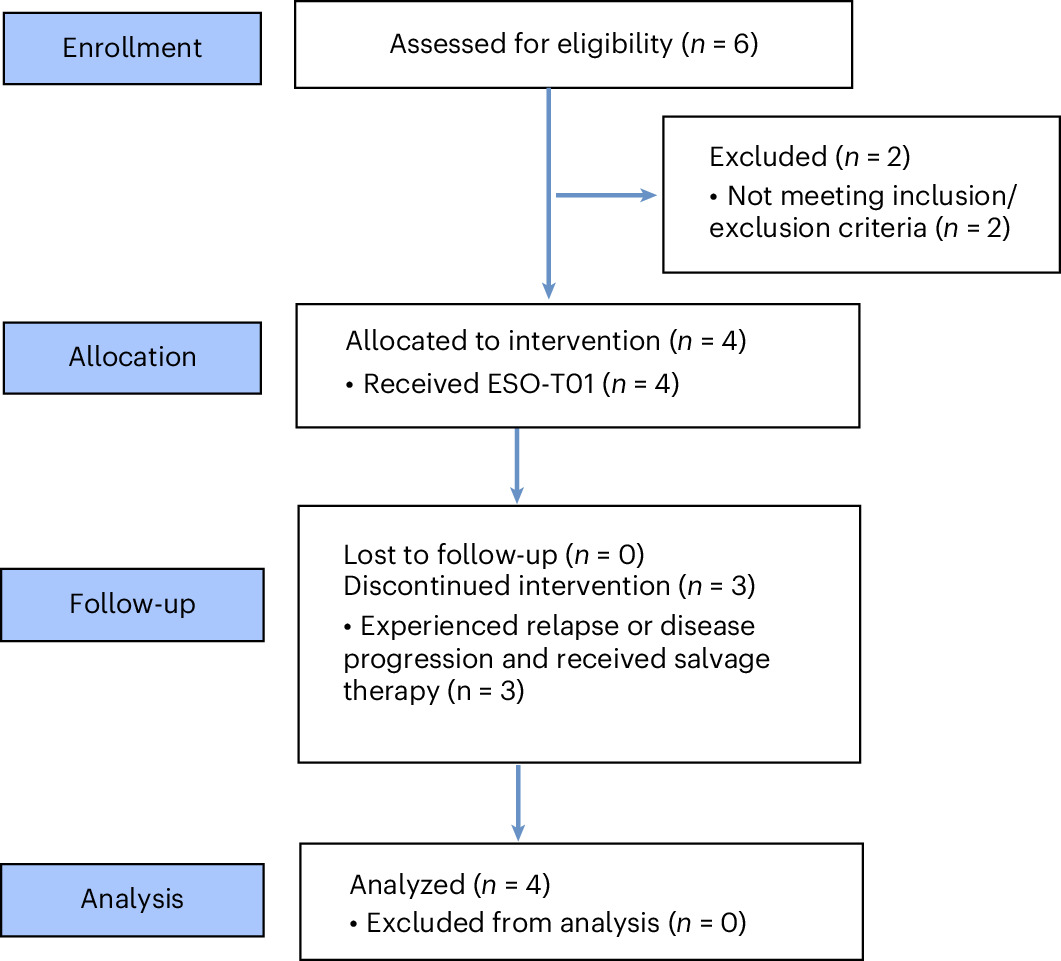
All four patients initially responded, but three relapsed or progressed after 3–5 months.
One patient maintained stringent complete response for 15 months.
WHY IT MATTERS
The follow-up shows that feasibility of in vivo CAR-T does not yet mean durable disease control.
CAR-T persistence emerges as a central problem that must be solved before this approach can be fairly compared with conventional CAR-T.
WHAT IS NOW POSSIBLE
Before: the approach had early proof-of-concept responses with short follow-up. Now: one response has remained stringent complete to 15 months, while three of four responses proved short-lived.
WHAT MADE IT POSSIBLE
ESO-T01 uses a lentiviral vector to deliver a BCMA-directed CAR directly to a patient's T cells.
Extended observation of the same small cohort now reveals response durability beyond the first few months.
THE STORY
A CAR-T therapy generated directly inside the body, rather than by removing and engineering a patient's cells in a laboratory, has shown two very different sides in its first longer follow-up: all four patients with multiple myeloma initially responded, but in three the response lasted only a few months.
The phase 1 study concerns ESO-T01, a lentiviral vector that gives a patient's T cells instructions to recognize BCMA. The initial report followed patients for only a few months. The new paper extends observation to as long as 15 months.
One patient maintained a stringent complete response through 15 months. The other three relapsed or progressed after 5, 3 and 3 months. Median progression-free survival was 4 months.
No important new treatment-related adverse events emerged during the extended follow-up, but the initial safety picture was not trivial: every patient had experienced cytokine release syndrome and grade 3 or higher hematotoxicity.
This does not show that in vivo CAR-T is better than or equivalent to conventional CAR-T. With four patients and no control group, the value of the follow-up is mainly clinical and engineering evidence: making CAR-T cells directly in the body is feasible, but response persistence remains a major constraint.
WHAT WE KNOW
In-vivo generation of BCMA CAR-T cells produced initial responses in all four treated patients. [1]
One patient maintained stringent complete response for 15 months.
Three patients relapsed or progressed within five months.
WHAT WE DON'T KNOW
Efficacy compared with ex vivo manufactured CAR-T is unknown.
Four patients cannot provide reliable response, durability or safety rates.
It remains unclear how to improve persistence of in-vivo-generated CAR-T cells.
WHAT HAPPENS NEXT
Larger prospective cohorts are needed.
The platform needs better persistence and control of extramedullary relapse.
Future studies must clarify longer-term safety and durability in broader populations.
SOURCE TRACE
All four treated patients achieved an objective response: two stringent complete responses and two partial responses.
One patient maintained stringent complete response for 15 months, while three relapsed or progressed at 5, 3 and 3 months; median progression-free survival was 4.0 months.
No important new ESO-T01-related adverse events emerged during follow-up beyond the initial report, although all four patients had experienced cytokine release syndrome and grade 3 or higher hematotoxicities.
SOURCES
- Extended follow-up of in vivo BCMA CAR-T therapy in relapsed/refractory multiple myelomaOpen source
- A Clinical Study to Evaluate the Safety and Efficacy of ESO-T01 in Treating Relapsed/Refractory Multiple MyelomaOpen source
CURRENT EVIDENCE
PEER-REVIEWED
EARLY PHASE 1 HUMAN FOLLOW-UP
WHAT WOULD CHANGE THIS?
- Prospective larger-cohort data showing durable responses are common.
- A direct comparison with ex vivo CAR-T.
- New evidence of delayed vector-related or integration-related toxicity.