
IN BRIEF
Eleven Chinese adolescents aged 12–18 with severe or moderately severe hemophilia B received a single AAV gene therapy infusion.
Mean annualized bleeding rate fell from 13.9 to 0.5 during the first 52 weeks.
Mean factor IX activity reached 41.8 IU/dl at one year; investigators recorded adverse events including one serious event and two grade 3 events.
WHY IT MATTERS
Severe hemophilia B can cause repeated bleeding episodes and lifelong reliance on clotting-factor treatment. Durable factor IX production after one intervention could potentially reduce the treatment burden.
Results in adults were already available. The new evidence concerns adolescents, for whom sustained expression and safety during growth are important unanswered questions.
WHAT IS NOW POSSIBLE
Before: only adult clinical outcomes for this gene therapy were established. Now: an adolescent phase 1 cohort has direct one-year factor and bleeding outcomes.
WHAT MADE IT POSSIBLE
An AAV843 viral vector delivers a gene encoding the highly active Padua form of clotting factor IX to liver cells.
Investigators tracked factor activity, bleeding events and safety markers after infusion.
THE STORY
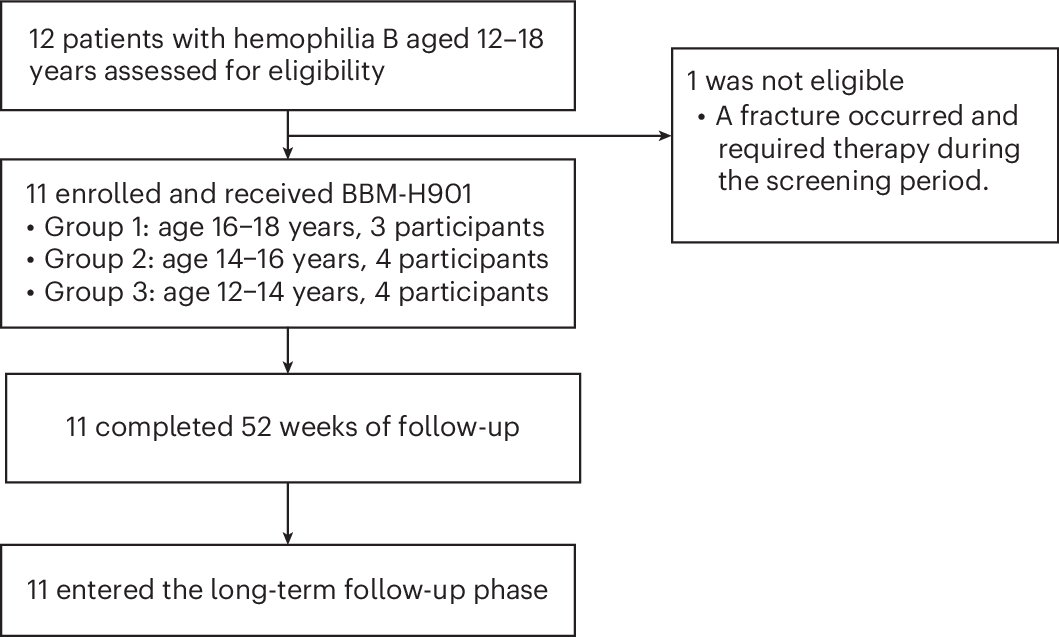
Gene therapy has already shown important benefits for adults with hemophilia B, but adolescents raise different questions about development and the durability of gene expression. Researchers in China have studied BBM-H901, a therapy using an adeno-associated viral vector to deliver the factor IX Padua gene to the liver. Their phase 1 trial, published in Nature Medicine on 16 September 2026, enrolled eleven adolescents aged 12 to 18.
All participants had severe or moderately severe hemophilia B, with factor IX clotting activity at or below 2 IU/dl. Each received a dose of 5 × 10¹² vector genomes per kilogram and was followed for 52 weeks. Because there was no randomized comparison group, bleeding outcomes were compared within participants before and after gene therapy rather than against a parallel standard-treatment group.
Mean annualized bleeding rate declined from 13.9 to 0.5. At 52 weeks, mean factor IX activity by the one-stage SynthASil assay reached 41.8 IU/dl, with substantial variation among participants. The outcome combines a biological signal, increased clotting-factor activity, with a directly meaningful clinical event, fewer bleeds. Yet eleven participants provide a small and potentially variable estimate.
Safety was the primary endpoint. No dose-limiting toxicity occurred, but the study did record one serious adverse event and two grade 3 events. One participant experienced elevated liver enzymes that returned to normal four weeks after immunosuppressive treatment. Other adverse events included elevated white blood cell counts and corticosteroid-associated symptoms. An absence of dose-limiting toxicity should not be interpreted as an absence of risk.
The group had already published adult BBM-H901 trials in 2025, including phase 3 research. The new event is the adolescent cohort. Developer Belief Biomed supplied the therapy and participated in the design, making independent scrutiny especially valuable. A one-year follow-up cannot determine how long the benefit lasts during adolescence or whether delayed harms emerge. Larger studies and longer observation are required before the safety and effectiveness of treatment in this age group can be considered established.
WHAT WE KNOW
Eleven adolescents with hemophilia B received BBM-H901 in a multicenter phase 1 trial. [1]
Mean annualized bleeding rate fell from 13.9 to 0.5 in the observation period.
Mean factor IX activity at 52 weeks was 41.8 IU/dl, with documented adverse events.
WHAT WE DON'T KNOW
Durability of the response over many years in growing adolescents is unknown.
There is no concurrent randomized control for comparing effectiveness with other care.
Long-term developmental and liver safety are not established.
WHAT HAPPENS NEXT
Continue monitoring factor IX activity, bleeding and liver function for years.
Study more adolescents and appropriate treatment comparisons.
Evaluate benefit durability and potential effects during growth.
SOURCE TRACE
Eleven adolescents followed for 52 weeks in an uncontrolled phase 1 trial.
Mean annualized bleeding rate fell from 13.9 to 0.5.
Mean factor IX activity at one year was 41.8 IU/dl.
One serious and two grade 3 adverse events, with no dose-limiting toxicity.
SOURCES
- Factor IX Padua AAV gene therapy in adolescents with hemophilia B: a phase 1 trialOpen source
- Factor IX-Padua AAV gene therapy in hemophilia B: phases 1/2 and 3 trialsOpen source
CURRENT EVIDENCE
PEER-REVIEWED
ONE YEAR REAL PATIENT PHASE 1 CLINICAL OUTCOME / NOT FULLY VALIDATED
WHAT WOULD CHANGE THIS?
- Multiyear follow-up would test factor IX expression durability.
- Larger controlled studies would refine benefit and risk estimates.
- Growth and development data could change patient eligibility assessments.