
IN BRIEF
Investigators compared biopsies from 10 people with enterocolitis after BCMA CAR-T, 7 CAR-T-treated controls without the complication and 26 healthy volunteers.
Highly cytotoxic CAR-T cells persisted alongside depletion of B cells and plasma cells and broad inflammatory tissue remodeling.
Two patients improved after upadacitinib, but case observations cannot establish clinical efficacy or safety for this complication.
WHY IT MATTERS
CAR-T therapies have transformed treatment for some cancers but can also cause severe adverse effects. Understanding intestinal inflammation may help design safer, targeted strategies for patients receiving them.
The observed damage is not explained by loss of B cells alone. Persistent CAR-T cells and changes across other intestinal cells suggest a multicompartment syndrome.
WHAT IS NOW POSSIBLE
Before: mechanistic understanding focused on B lineage depletion. Now: biopsies reveal a broader multisystem inflammatory program and two preliminary examples of mechanism-guided treatment response.
WHAT MADE IT POSSIBLE
The team studied intestinal biopsies using single-cell RNA sequencing, flow cytometry and tissue microscopy.
Comparing patients who received similar therapy with and without enterocolitis helped isolate features associated with the complication, without proving a single causal trigger.
THE STORY
CAR-T treatments engineer immune cells to attack cancer, offering important options for some people with multiple myeloma. A severe intestinal complication can nevertheless occur after therapies directed against BCMA. Researchers have now examined the affected tissue directly, finding a more complex inflammatory response than simple depletion of B-lineage cells. The findings were published in Nature Medicine on 23 September 2026.
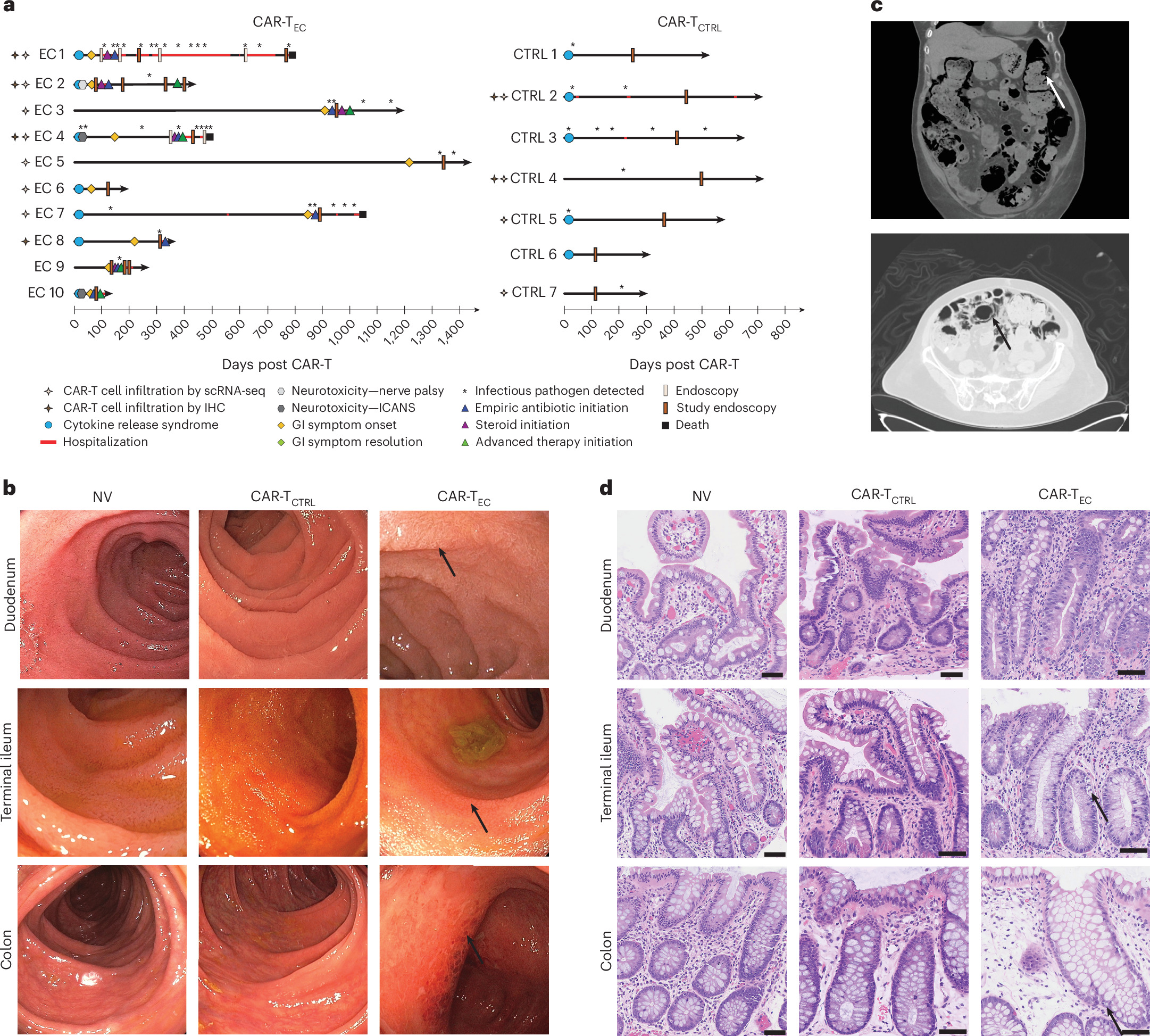
The analysis included intestinal biopsies from ten patients with CAR-T-associated enterocolitis, seven patients who had received CAR-T without enterocolitis and 26 healthy volunteers. Although these groups are small, the methods provided unusually detailed cellular information. Single-cell sequencing, flow cytometry and imaging identified which immune and tissue cell populations were present and which inflammatory pathways were active.
The inflamed mucosa showed severe depletion of B cells and plasma cells but also an expansion of highly cytotoxic CAR-T cells. Macrophages, monocytes, stromal cells, glia, endothelial cells and epithelium displayed altered states. Interferon-related and JAK-STAT signaling programmes were prominent. Together, the findings suggest disruption across an intestinal tissue ecosystem, not proof that any one detected cell population alone causes the disease.
Because JAK-related pathways appeared active, the investigators explored a drug targeting JAK1. Two patients with enterocolitis received upadacitinib and improved clinically, on endoscopy and in tissue assessments. That observation is encouraging but highly preliminary. Without a control group it cannot establish what would have happened otherwise, how many patients might respond or whether adverse effects would outweigh benefits in this setting.
The main advance is therefore a detailed map of what severe inflammation looks like in real CAR-T-treated patients and a testable mechanism for future research. Engineered cells intended to attack cancer can persist in the intestinal mucosa while local immune and structural systems change. Larger cohorts and controlled treatment studies are needed to learn how to manage this complication without compromising anticancer efficacy or increasing infection risks.
WHAT WE KNOW
Biopsies revealed persistent cytotoxic CAR-T cells and remodeling across multiple intestinal compartments. [1]
The comparison involved ten enterocolitis patients, seven CAR-T-treated controls and 26 healthy volunteers.
Two upadacitinib-treated patients showed clinical, endoscopic and histological improvement.
WHAT WE DON'T KNOW
The overall rate of this complication and the exact causal role of each cell population remain uncertain.
Two cases cannot establish efficacy or safety of JAK inhibition.
The optimal balance between controlling enterocolitis and preserving cancer treatment efficacy is unknown.
WHAT HAPPENS NEXT
Replicate tissue findings in larger cohorts with longer follow-up.
Conduct controlled studies of targeted anti-inflammatory approaches.
Measure gastrointestinal symptoms alongside infections and myeloma outcomes.
SOURCE TRACE
Biopsies came from 10 cases, 7 CAR-T controls and 26 healthy volunteers.
The tissue showed cytotoxic CAR-T cells and changes across multiple compartments.
Two patients improved after upadacitinib, not controlled evidence of efficacy.
SOURCES
- Persistence of mucosal CAR-T cells and inflammatory remodeling in enterocolitis associated with BCMA CAR-T cell therapyOpen source
- Persistence of mucosal CAR-T cells and inflammatory remodeling in enterocolitis associated with BCMA CAR-T cell therapyOpen source
CURRENT EVIDENCE
PEER-REVIEWED
REAL PATIENT TISSUE PROFILING / TREATMENT HYPOTHESIS NOT VALIDATED
WHAT WOULD CHANGE THIS?
- Larger studies could separate causes from correlated inflammation.
- Controlled trials could measure the benefits and risks of JAK inhibitors.
- Longer follow-up could assess the balance between gut health and tumor control.