
IN BRIEF
August 2026 reached 21.07°C: the new record concerns the comparison between Septembers.
The ocean temperature series used for this ranking begins in 1979.
WHY IT MATTERS
The result sets a new reference for comparing future Septembers across a broad ocean region. Regional maps are also needed to show where the heat is concentrated within that average.
WHAT IS NOW POSSIBLE
È ora documentato un nuovo massimo di settembre: 21,05 °C per la superficie marina fra 60° sud e 60° nord, contro 20,92 °C nel 2023.A new September high is now documented: 21.05°C for the ocean surface between 60° south and 60° north, compared with 20.92°C in 2023.
WHAT MADE IT POSSIBLE
The bulletin uses ERA5, a reanalysis that reconstructs past conditions by combining observations with physical models. Its ocean temperature component incorporates external analyses: since September 2007, daily OSTIA data from the Met Office.
THE STORY
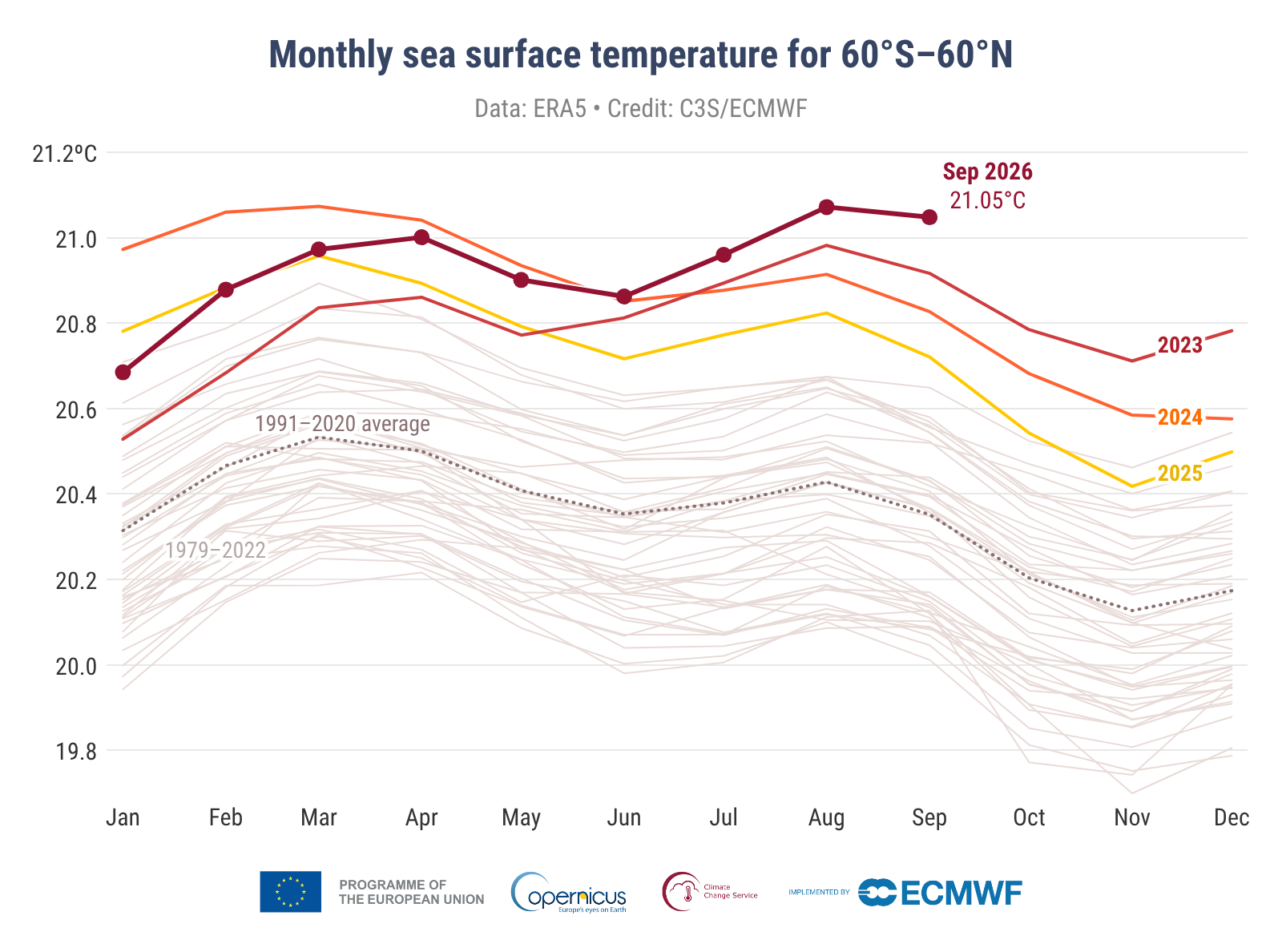
In the original bulletin chart, available in high resolution, the annual curves follow the monthly averages; the dotted line shows the 1991–2020 average. September values from different years line up at the same point on the horizontal axis. Holding the month constant makes the record visible without confusing it with seasonal variation.

Here, sea surface temperature means an estimate representing water roughly ten metres below the surface. Products describing different ocean layers can return different values. The record therefore needs to be read alongside the dataset’s name and geographical coverage.
The same bulletin reports a September global air temperature anomaly of +1.63°C relative to 1850–1900. The Paris Agreement’s 1.5°C threshold concerns long-term warming: a single month does not establish that it has been crossed.
Cover chart: original image from the Copernicus September 2026 bulletin. Source: Copernicus Climate Change Service, C3S/ECMWF. Data: ERA5, 2026. Licence to Use Copernicus Products v1.2. Neither the European Commission nor ECMWF is responsible for the use made of the information reproduced here. The complete figure is available at the link; previews may crop it for display. The original file, data and axes remain unchanged.
WHAT WE KNOW
The finding appears in the Copernicus release dated 9 October 2026. [1][2][3][4][5]
WHAT WE DON'T KNOW
The average alone does not quantify consequences for individual marine ecosystems. Local data on the duration and intensity of the heat, together with biological observations, are also needed.
WHAT HAPPENS NEXT
Future bulletins will allow each new month to be compared with the same month in earlier years.
SOURCE TRACE
Mean sea surface temperature between 60°S and 60°N was 21.05°C in September 2026, a September record in the bulletin's series.
The previous September record over the same domain was 20.92°C in 2023.
August 2026 mean SST over the same domain was 21.07°C, higher than September 2026.
The SST series used in the bulletin begins in 1979.
ERA5 reconstructs past conditions by combining observations with physical models.
ERA5's SST component uses external analyses, with daily Met Office OSTIA data from September 2007 onward.
The ocean temperature represents water at roughly ten metres; products representing other depths may give different values.
The chart compares annual series of monthly mean ocean temperatures between 60°S and 60°N.
The +1.63°C relative to 1850–1900 concerns September 2026 global air temperature.
The Paris Agreement's 1.5°C threshold concerns long-term warming; a single month does not establish its crossing.
The release is dated 9 October 2026; the webpage separately displays 12 October 2026.
SOURCES
- Surface air temperature for September 2026Open source
- Copernicus: Second warmest September as global temperatures stay above 1.5°COpen source
- Climate Bulletin - About the data and analysisOpen source
- ERA5 hourly data on single levels from 1940 to presentOpen source
- Copernicus: 2024 is the first year to exceed 1.5°C above pre-industrial levelOpen source
- Disclaimer and privacyOpen source
- Licence to Use Copernicus Products, version 1.2Open source
CURRENT EVIDENCE
VALIDATED EVIDENCE
OBSERVED_TEMPERATURE_RECORD