
IN BRIEF
Images were taken on 16–24 September 2026; the Minor Planet Center confirmed the comet on 8 October; ESA announced it on 19 October.
Euclid’s first comet discovery follows earlier observations of already catalogued objects.
WHY IT MATTERS
A new body joins the objects astronomers can follow over time. The discovery also shows the value of revisiting astronomical images with fresh questions. Nearby and distant phenomena share the same frame, and different ways of analysing it can bring different objects into view.
WHAT IS NOW POSSIBLE
Un oggetto prima assente dai cataloghi consultati è ora identificato come cometa e può essere seguito collegando le nuove osservazioni.An object missing from the checked catalogues is now identified as a comet and can be tracked by linking further observations.
WHAT MADE IT POSSIBLE
Mikko Pöntinen’s software flagged the movement. Euclid measures successive patches of sky, pausing between shifts; comparing the images helps reveal objects changing position against the background.
THE STORY
Checks against comet and asteroid catalogues found no match. Reporting the object to the Minor Planet Center alerted ground-based astronomers, enabling follow-up observations. The Center subsequently confirmed the comet.
That sequence makes the discovery verifiable: other observers can look for the same body and add measurements. Linking separate detections allows its path to be reconstructed, while retaining the uncertainties attached to each observation.
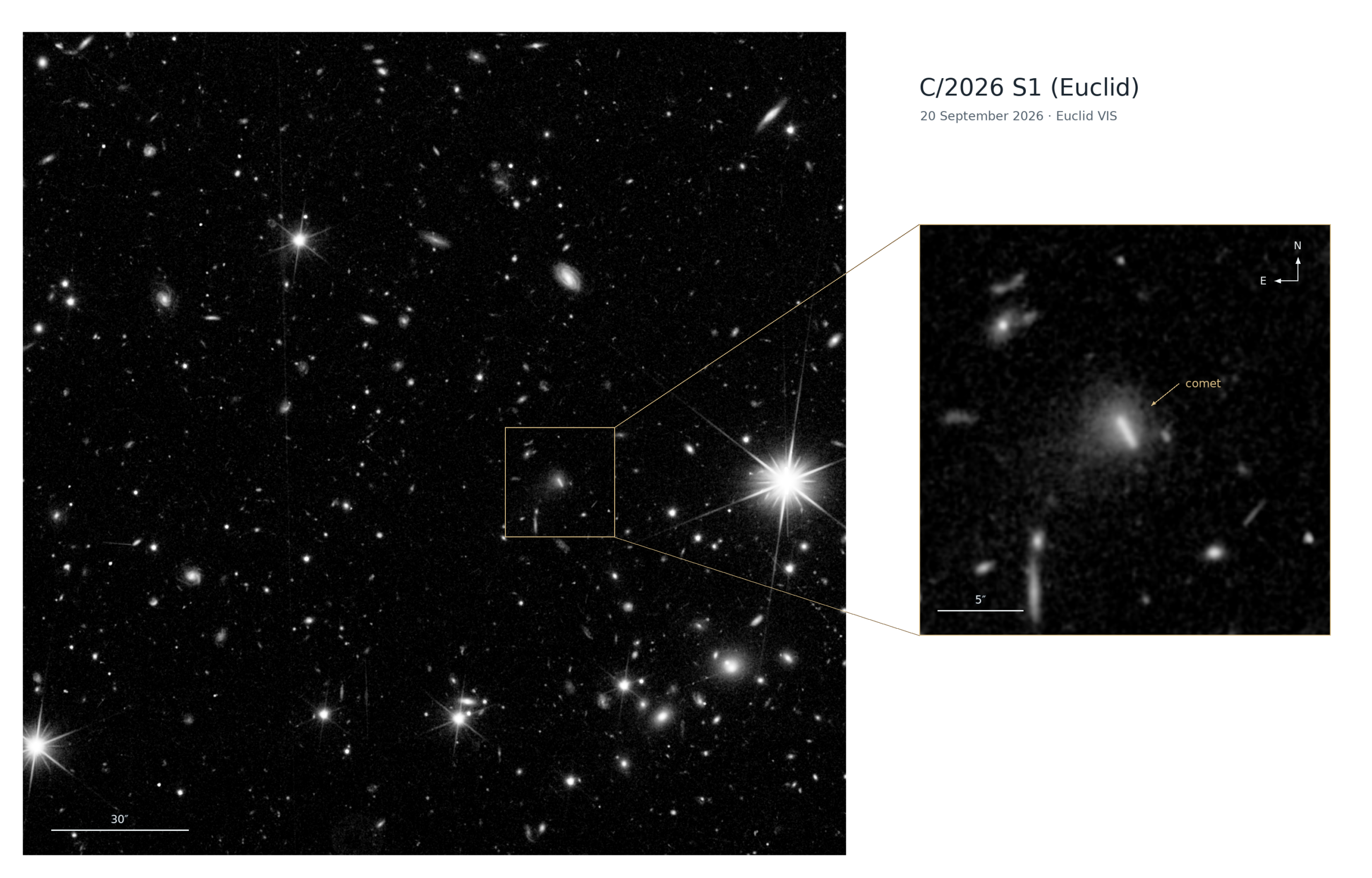
In the cover image, taken on 20 September with a 560.52-second exposure, the comet looks elongated. The streak records its movement while the camera collects light, so its length also depends on how long the exposure lasts.
Around it lies the coma, a halo of gas and dust surrounding the icy nucleus. Released material can scatter light across a region much larger than the solid body. This envelope gives comets their fuzzy appearance.
Cover image: Comet C/2026 S1 (Euclid) observations in context. Credit: ESA/Euclid/Euclid Consortium/NASA, M. Pöntinen et al. 2026. CC BY-SA 3.0 IGO. Documentary image with the original inset and annotations; it may be resized for display, with no changes to its content.
WHAT WE KNOW
Sixteen exposures, five fields of view. Circular MPEC 2026-T146 records the name under which further observations of the same object can be linked. [1][2][3][4][5][6]
WHAT WE DON'T KNOW
The orbit still needs refinement. The available positions describe part of its path, so assigning a precise orbital period would be premature. This comet is not a suitable target for Comet Interceptor.
WHAT HAPPENS NEXT
Additional positions measured over time can refine the orbit. The useful change to watch is a reduction in uncertainty about future positions: that is where each new measurement can show its contribution.
SOURCE TRACE
First unknown comet
September; 8/10; 19/10
Pöntinen’s software
Successive pointings and measurements
20 September; 560.52 seconds
Coma: gas and dust around nucleus
1.3 billion km
16 exposures/5 fields
Orbit needs refinement
Comet Interceptor excluded
No catalogue match
The report alerted ground-based astronomers, enabling further observations.
SOURCES
- Euclid discovers new cometOpen source
- MPECs for 2026Open source
- Comet C/2026 S1 (Euclid) observations in contextOpen source
- A composite of eight Euclid VIS exposures of Comet C/2026 S1 (Euclid)Open source
- Comet FactsOpen source
- How Euclid scans the skyOpen source
- MPEC 2026-T146: COMET C/2026 S1 (Euclid)Open source
CURRENT EVIDENCE
VALIDATED EVIDENCE
CONFIRMED_ASTRONOMICAL_OBSERVATION