
IN BRIEF
Researchers introduced many small genetic modules into mammalian cells, screening millions of combinations for working biosynthetic pathways.
Some engineered Chinese hamster ovary cells grew without added valine at near-control growth rates, while others acquired the ability to grow without isoleucine.
Valine-independent growth was also achieved in a human Jurkat T-cell line in culture, not in people receiving cell therapy.
WHY IT MATTERS
Mammalian cells normally depend on an external supply of essential amino acids because their biosynthetic pathways are incomplete. Restoring a complex pathway gives researchers a new way to probe nutrient use and metabolic control.
The experiment does not establish a treatment that can run independently of nutrients inside patients. It demonstrates a new capability in laboratory cell lines and a method for exploring genetic combinations that are hard to design one at a time.
WHAT IS NOW POSSIBLE
Before: valine independence was slow and isoleucine independence unavailable in the tested CHO system. Now: optimized CHO valine growth, six-gene isoleucine independence and valine independence in Jurkat cells have been demonstrated in culture.
WHAT MADE IT POSSIBLE
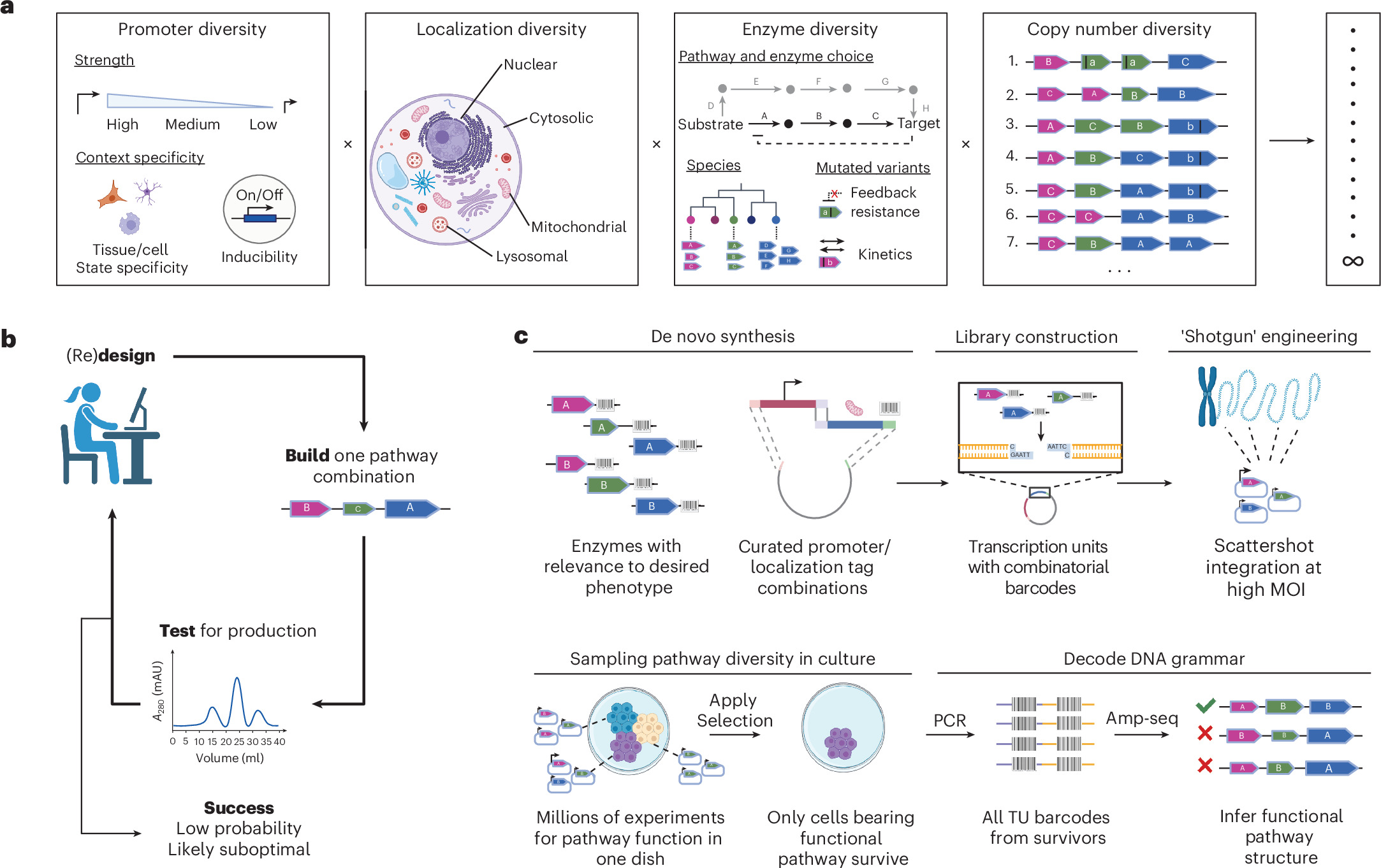
The researchers built a library of small DNA units with barcodes, then delivered different combinations to many cells. Growth under amino-acid deprivation selected cells containing functional pathways.
Sequencing the barcodes identified which genes and intracellular locations supported the new function. Targeting components to mitochondria proved especially important.
THE STORY
Mammalian cells normally require external supplies of certain essential amino acids. Synthetic biologists have now engineered laboratory cell lines that can produce some of those compounds for themselves. In work published in Nature Biotechnology on 6 October 2026, researchers screened millions of genetic combinations and selected cells able to grow without added valine or, in a separate experiment, isoleucine.
A striking result came from Chinese hamster ovary cells, a standard laboratory and biotechnology system. Earlier research had made valine-independent growth possible, but the cells doubled slowly, roughly every 3.8 days. The newly optimized cells approached a 1.1-day doubling time. A selected pathway rebuilt into one DNA construct yielded a 1.25-day doubling time, about 74% of the growth rate of valine-fed cells. In another experiment the team identified a six-gene solution enabling isoleucine-independent growth.
The challenge was not finding one useful enzyme. Biosynthetic pathways need several genes expressed at appropriate levels and in compatible parts of the cell. Building and testing every large genetic circuit individually would be impractical. The shotgun genetic engineering approach instead delivers pools of small barcoded DNA units, making each cell a distinct experiment. Cells surviving selective nutrient conditions reveal promising combinations when their barcodes are sequenced.
The researchers extended the method to Jurkat cells, an established human T-cell line maintained in the laboratory, and obtained growth without added valine. That suggests potential avenues for studying nutrient resilience in immune cells, but it does not demonstrate success in primary therapeutic T cells or in patients. Directing certain enzymes to mitochondria was particularly helpful, underscoring the value of exploring many cellular configurations.
The achievement remains a controlled cell-culture result. Integrating many DNA units may introduce variability and does not automatically establish safety or stability for treatment. What has been demonstrated is a strategy to discover and rebuild complex mammalian metabolic pathways. Industrial and clinical uses would require separate validation.
WHAT WE KNOW
Millions of genetic pathway combinations were screened in mammalian cell lines. [1][2]
Optimized Chinese hamster ovary cells grew efficiently without added valine and other cells acquired isoleucine-independent growth.
Valine-independent growth was also observed in cultured human Jurkat T cells.
WHAT WE DON'T KNOW
The safety and stability of these pathways in primary human cells are not established.
Culture-medium independence does not demonstrate a clinical or industrial benefit.
Multiple DNA integrations create questions about reproducibility and downstream genetic effects.
WHAT HAPPENS NEXT
Measure long-term pathway stability across cell types.
Reduce and control DNA integration after large-scale discovery.
Test in systems closer to eventual manufacturing or clinical use while preserving evidence-stage distinctions.
SOURCE TRACE
Optimized CHO cells grew without added valine, doubling near 1.1 days.
A six-gene pathway enabled CHO cells to grow without added isoleucine.
Valine-independent growth was achieved in cultured human Jurkat T cells.
SGE screened millions of barcoded genetic combinations in parallel.
SOURCES
- Highly multiplexed mammalian metabolic engineering with a shotgun approachOpen source
- High-throughput metabolic engineering in mammalian cellsOpen source
CURRENT EVIDENCE
PEER-REVIEWED
PHYSICAL LABORATORY CULTURE / NOT HUMAN CLINICAL
WHAT WOULD CHANGE THIS?
- Tests on primary human cells would evaluate transfer to more clinically relevant systems.
- Long-term stability studies could clarify genetic risks.
- Reproducible manufacturing deployment would establish a different application stage.