
IN BRIEF
Scientists compared CO₂ surface chemistry on calcium- and magnesium-bearing olivine, focusing on the role of reactive oxygen atoms.
In the calcium-rich system, surface carbonation cut the calculated ion-release barrier by 60% and raised the predicted ion release rate by six orders of magnitude.
The model agrees with earlier laboratory conversion of calcium-rich olivine within hours under one-atmosphere CO₂, not with any demonstration of large-scale geological injection.
WHY IT MATTERS
Mineral carbonation can store carbon dioxide as stable solid compounds rather than leaving it in the atmosphere.
Reaction speed and process energy are crucial. Understanding why specific mineral surfaces react rapidly may support engineering decisions without assuming every rock performs the same way.
WHAT IS NOW POSSIBLE
Before: observed rate differences lacked an explicit predictive surface mechanism. Now: model connects reactive oxygen configurations to lower dissolution barriers and measured lab conversion.
WHAT MADE IT POSSIBLE
First-principles molecular simulations traced how carbon dioxide interacts with oxygen sites on mineral surfaces.
Comparisons between different olivines and existing experimental observations tested whether predicted reaction rates were plausible.
THE STORY
Carbon dioxide can become part of a stable solid when it reacts with suitable rocks. Yet some minerals transform in hours while others change far more slowly. A paper published in Nature Communications on 14 October 2026 gives an atomic-scale explanation for this striking difference between calcium-bearing and magnesium-rich olivines. The advance is not that mineral carbonation has suddenly been invented, but that researchers can better predict why one surface reacts so much faster.
Olivine refers to a family of silicate minerals found in rocks, including magnesium-rich formations. As carbon dioxide interacts with a suitable surface, chemical reactions can facilitate ion release from the solid and ultimately carbonate formation. Simply naming the metal ion, however, does not fully explain the reaction-rate contrast. Calcium and magnesium also influence how reactive the oxygen atoms at the surface become.
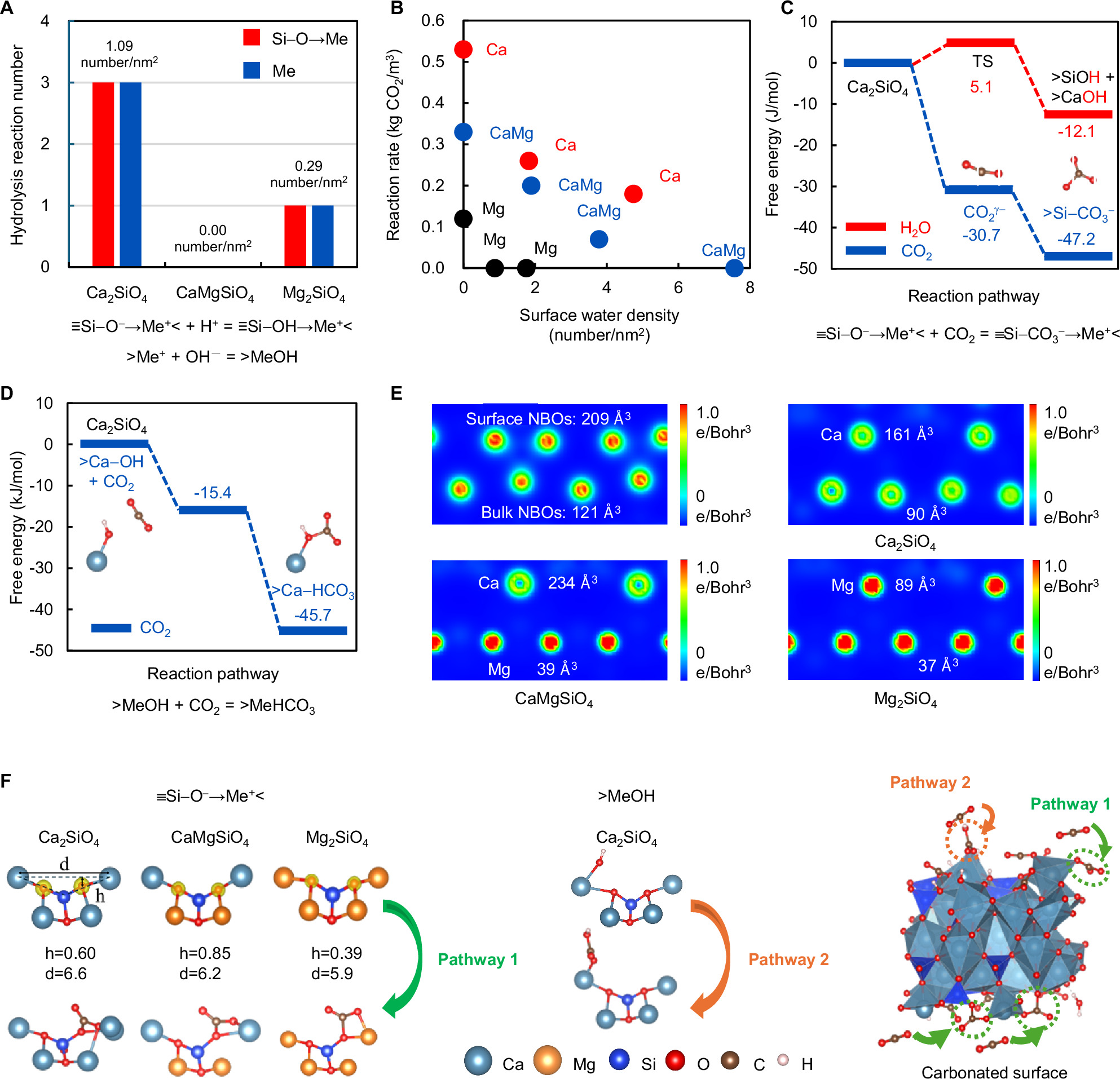
The team used first-principles molecular calculations to identify nonbridging oxygen sites as crucial partners in CO₂ surface reactions. For calcium-bearing olivine, the model found that carbonation lowered the calculated barrier to calcium ion dissolution by 60%. The resulting predicted ion-release rate rose by six orders of magnitude, roughly a millionfold, relative to the studied reference condition. That figure describes a specific calculated chemical comparison, not a universal claim about how fast any rock can store carbon.
Researchers then used their results to calculate apparent reaction-rate constants and compared them with experimental evidence. The calculations reproduced the reported complete conversion of calcium olivine within hours under carbon dioxide at one atmosphere in laboratory conditions. Connecting atomic mechanisms with macroscopic experimental behavior is valuable. It is not evidence that a natural underground formation was mineralized within hours.
Moving beyond the laboratory requires answering a different set of questions: where suitable material can be obtained, how CO₂ and water are transported into it, how much energy processing consumes and whether products remain stable. Natural rocks also contain impurities and fractured structures that can change chemistry. The new work offers a more predictive foundation for carbon mineralization, but its climate value depends on real-material tests and a whole-process emissions balance.
WHAT WE KNOW
The model identifies reactive surface oxygen sites as central to the mineral CO₂ reaction. [1]
In the calcium system the calculated barrier was reduced 60% and ion release accelerated by six orders of magnitude.
Predicted rates agree with earlier laboratory calcium-olivine conversion over hours at one-atmosphere CO₂.
WHAT WE DON'T KNOW
The same rapid conversion has not been demonstrated for massive natural rock formations.
Commercial processing cost and full-system emissions were not established.
Impurities and different geological conditions could change the reaction.
WHAT HAPPENS NEXT
Test the predicted mechanism in heterogeneous natural rock samples.
Evaluate transport, carbonation products and stability in pilot conditions.
Calculate realistic energy demand and net climate impact.
SOURCE TRACE
Nonbridging surface oxygen atoms drive CO2 reactions governing different olivine dissolution reactivity.
Calcium-olivine surface carbonation reduced the calculated calcium ion dissolution barrier 60 percent.
The model predicted six orders of magnitude increase in calcium ion release rate under compared conditions.
Apparent predicted dissolution rates reproduced laboratory complete conversion of calcium olivine within hours under 1 atm CO2.
SOURCES
- Surface carbonation governs olivine reactivity for rapid CO2 mineralizationOpen source
- CO2を高速に固定できる岩石を見つけ出す ―カンラン石の反応速度を予測する新しいモデル―Open source
CURRENT EVIDENCE
PEER-REVIEWED
ATOMISTIC EXPLANATION MATCHING LABORATORY RESULTS / NOT FIELD CO2 REMOVAL
WHAT WOULD CHANGE THIS?
- Tests in natural rocks may yield different reaction rates.
- Pilot systems could establish real costs and mineral stability.
- Lifecycle assessments could quantify net climate benefits.