
IN BRIEF
The study uses 20 years of wave data across globally distributed sites.
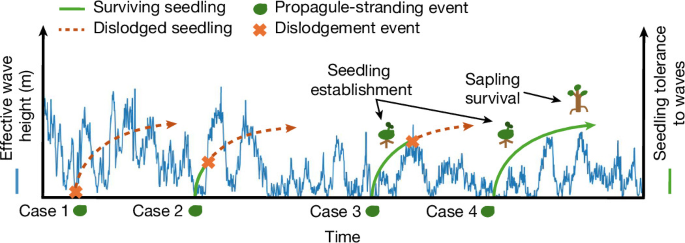
Seedlings are most vulnerable early on, so periods without excessive wave forcing give them time to anchor.
The model reaches 78.2% accuracy but does not include every local factor controlling mangrove growth.
WHY IT MATTERS
A coastline can have suitable climate and sediment yet still fail as habitat if waves repeatedly interrupt the most fragile establishment stage.
For restoration, that means asking not only where a mangrove could live, but whether it will get enough quiet time to start living there.
WHAT IS NOW POSSIBLE
A previously underrepresented physical bottleneck—whether seedlings experience uninterrupted low-wave periods as they become harder to dislodge—can now explain much of the global open-coast presence pattern and be tested in restoration planning.
WHAT MADE IT POSSIBLE
The team combined 20 years of Copernicus wave reanalysis, Global Mangrove Watch sites and a physical model in which seedling tolerance increases as plants age.
THE STORY
A young mangrove does not need to withstand waves forever; it first needs enough time to take root. A new global study shows that this establishment stage can explain much of where mangroves do — and do not — occupy open coasts.
The researchers looked for what they call 'windows of opportunity': intervals when waves remain weak enough not to dislodge a seedling before it becomes more resistant. The model tests those windows against 20 years of wave conditions.
Across 394 sites with valid data, roughly split between mangrove and non-mangrove coasts, the wave-and-shoreline mechanism correctly classified presence or absence 78.2% of the time.
That changes the intuitive model of distribution. It is not only how often a coast floods or what the average wave looks like; the sequence matters — whether an uninterrupted calm period arrives while a seedling is still easy to dislodge.
In sensitivity tests, moderate changes in wave forcing made some modeled stretches entirely more or less suitable for establishment. These are not local forecasts, however: salinity, sediment, sea level, cyclones, species and human shoreline change remain important.
WHAT WE KNOW
Four hundred global sites were selected; 394 had valid hydrodynamic data. [1][2]
The model uses three-hourly wave data from 2003 through 2023.
Reported overall classification accuracy is 78.2%.
The article is peer reviewed, open access and published in Nature.
WHAT WE DON'T KNOW
How well the model performs without local calibration in individual restoration projects.
How calm-window frequency will change along each coastline under future climate conditions.
How species differences change wave-tolerance thresholds.
How much omitted local factors explain the remaining error.
WHAT HAPPENS NEXT
A useful next test is validation against observed historical mangrove expansion and retreat and against local field measurements before site selection.
Regional wave and sea-level projections can then turn the mechanism into more realistic coastal scenarios.
SOURCE TRACE
The study analyzed 20 years of 3-hourly wave data at 400 globally distributed open-coast sites, with valid hydrodynamic data at 197 mangrove and 197 non-mangrove sites.
The process-driven model achieved 78.2% overall accuracy in classifying mangrove presence or absence using wave forcing and shoreline geometry.
The model is based on 'windows of opportunity': periods when wave forcing stays below age-dependent thresholds long enough for seedlings to anchor and mature.
In case-study sensitivity tests, modest changes in effective wave forcing could switch entire stretches between suitable and unsuitable establishment conditions, although these are scenarios rather than local forecasts.
SOURCES
- Global mangrove distribution on the open coast is controlled by wavesOpen source
- Global mangrove distribution on the open coast is controlled by wavesOpen source
CURRENT EVIDENCE
VALIDATED EVIDENCE
Model built and tested against globally distributed observed mangrove/non-mangrove sites; scenario sensitivity to altered wave forcing assessed.
WHAT WOULD CHANGE THIS?
- Independent validation showing poor performance when predicting real coastline changes.
- Field data showing that other factors systematically dominate wave thresholds across most open coasts.
- Prospective restoration success using the model would make the finding substantially more operational.